
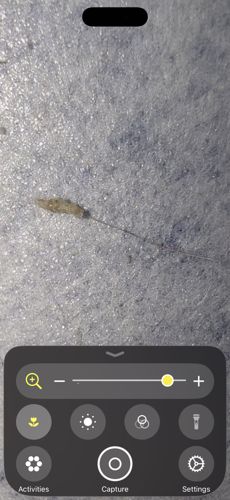
Community identification
Head louse (nit)
Pediculus humanus capitis
- Order & Family
- Order: Psocodea, Family: Pediculidae
- Size
- Nits are approximately 0.8 mm; adults are 2.1–3.3 mm.
Natural Habitat
The human scalp and hair shafts, particularly behind the ears and near the neckline.
Diet & Feeding
Exclusively human blood, consumed several times a day.
Behavior Patterns
Nits are eggs glued firmly to hair shafts. They cannot jump or fly; transmission occurs via direct head-to-head contact.
Risks & Benefits
Causes intense itching and scalp irritation. They are not known to spread disease, but secondary bacterial infections can occur from scratching.