
Community identification
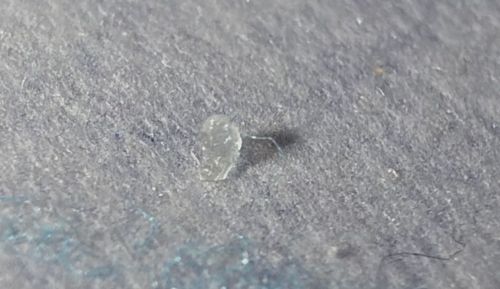
Scabies Mite (specifically referring to the molting skin or a dislodged specimen, often confused with skin flakes)
Sarcoptes scabiei var. hominis
- Order & Family
- Order: Sarcoptiformes, Family: Sarcoptidae
- Size
- Microscopic; adult females are 0.30–0.45 mm long and 0.25–0.35 mm wide; males are slightly smaller. (Note: The object in the image is visible to the naked eye, suggesting it might be a skin flake or debris often mistaken for a mite, or a magnification of a very small particle).
Natural Habitat
The epidermis (top layer) of human skin, where females burrow to lay eggs. Can survive for short periods (2-3 days) off a host on clothing or bedding.
Diet & Feeding
They feed on human skin cells and lymph fluid found within the epidermis.
Behavior Patterns
Females burrow into the skin to lay eggs, causing intense itching (especially at night). The lifecycle from egg to adult takes about 10-14 days. They are transmitted primarily through prolonged, direct skin-to-skin contact.
Risks & Benefits
Risks: Causes scabies, a highly contagious skin infestation characterized by intense itching and a pimple-like rash. Scratching can lead to secondary bacterial skin infections like impetigo. Not a vector for other diseases. No ecological benefits to humans.