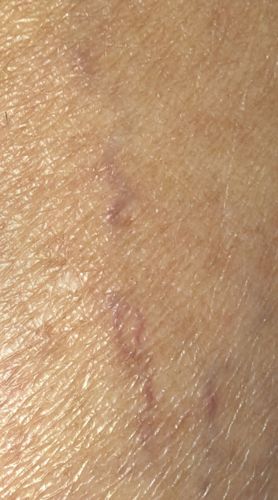
Scabies Mite (burrow shown)
Scientific Name: Sarcoptes scabiei var. hominis
Order & Family: Order: Sarcoptiformes, Family: Sarcoptidae
Size: Microscopic; adult females are 0.30–0.45 mm long and 0.25–0.35 mm wide; males are slightly smaller.
Natural Habitat
The epidermis (outer layer) of human skin; they cannot survive for more than 2-3 days away from a human host.
Diet & Feeding
Feeds on human skin cells and lymph fluid found within the stratum corneum (top layer of skin).
Behavior Patterns
The female mite burrows into the upper layer of the skin, creating visible serpiginous (wavy) tunnels where she lays eggs. The larvae hatch and travel to the skin surface to molt into adults.
Risks & Benefits
Risks: It causes scabies, an infestation characterized by intense itching (especially at night) and a pimple-like rash. It is highly contagious through direct, prolonged skin-to-skin contact. Secondary bacterial infections can occur from scratching. Benefits: There are no known benefits to humans or ecosystems.
Identified on: 2/20/2026