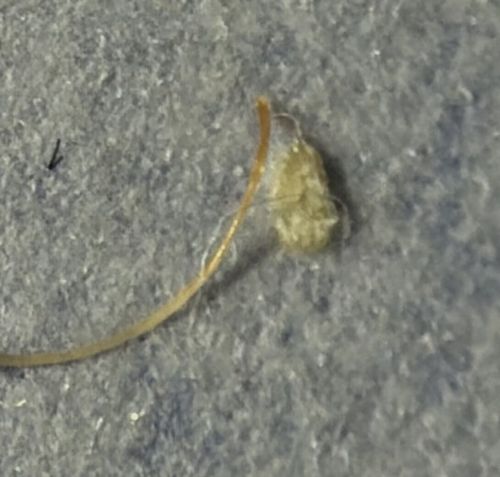
Head Louse Nit (Louse egg)
Scientific Name: Pediculus humanus capitis (egg)
Order & Family: Phthiraptera: Pediculidae
Size: Approximately 0.8 mm by 0.3 mm (roughly the size of a poppy seed).
Natural Habitat
Exclusively on the human scalp and hair, usually close to the neckline and behind the ears.
Diet & Feeding
The egg casing itself (nit) does not feed; the hatched nymph and adult louse feed exclusively on human blood obtained from the scalp.
Behavior Patterns
Nits are cemented firmly to the hair shaft by the adult female louse close to the scalp for warmth. They incubate for about 7-10 days before hatching. Unlike dandruff, they cannot be easily brushed or shaken off.
Risks & Benefits
Risks: Causes intense itching (pruritus) and can lead to secondary bacterial skin infections from scratching. Social stigma and nuisance. Benefits: None known to humans or the ecosystem.
Identified on: 2/10/2026