
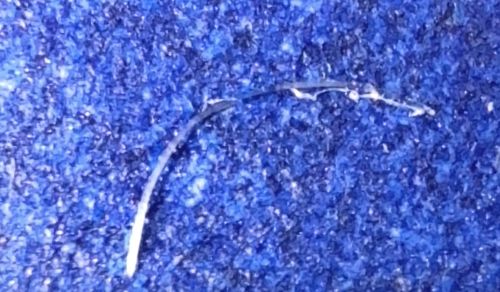
Horsehair Worm
Gordius species (Phylum Nematomorpha)
- Order & Family
- Order Gordioidea, family Gordiidae (among others in the Phylum Nematomorpha)
- Size
- Typically 4 to 14 inches (10 to 35 cm) long, but extremely thin (about 1 mm diameter), resembling a horse's hair.
Natural Habitat
Adults are free-living in freshwater bodies like puddles, streams, troughs, and swimming pools. Larvae are parasitic inside terrestrial insects like crickets, grasshoppers, and beetles.
Diet & Feeding
Adults do not feed; they rely on energy stored during their parasitic larval stage. Larvae absorb nutrients from the body of their arthropod host.
Behavior Patterns
Larvae develop inside an insect host and manipulate the host's behavior, often driving it to seek water so the adult worm can emerge to reproduce. They are often found writhing in tangled knots (Gordian knots) in water.
Risks & Benefits
Harmless to humans, pets, and plants. They do not infect mammals. They are considered beneficial in some contexts as they act as a natural biological control for pest insects like crickets and cockroaches.