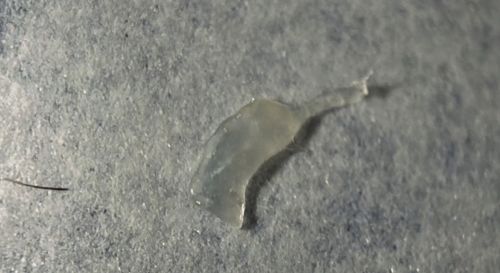
Hair Follicle Sheath (often mistaken for a parasite or skin worm)
Scientific Name: Not a living organism (Biological debris: Epithelial Root Sheath)
Order & Family: N/A (Derived from Human Integumentary System)
Size: Typically 1-3 mm in length
Natural Habitat
Found on the human scalp, surrounding the base of a hair follicle below the skin surface.
Diet & Feeding
Does not eat; it is composed of keratinized cells and tissue that protect the hair root.
Behavior Patterns
Stationary structure. It often becomes visible when a hair is plucked or falls out naturally during the telogen phase, appearing as a translucent, bulbous, or tube-like gel attached to the hair root.
Risks & Benefits
Benefits: Essential for hair growth and anchoring the hair shaft. Risks: None; it is harmless body tissue, though famously often misidentified by laypeople as 'Morgellons', lice eggs (nits), or skin worms, causing unnecessary anxiety.
Identified on: 3/4/2026