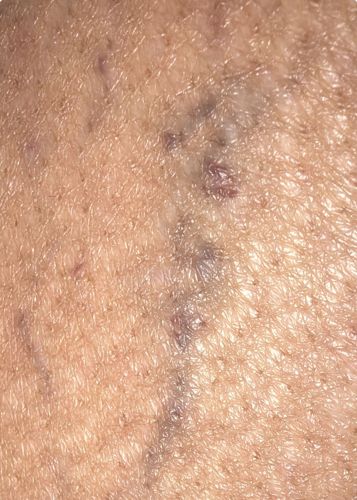
Scabies Mite (specifically referring to the burrow structure visible on skin)
Scientific Name: Sarcoptes scabiei var. hominis
Order & Family: Order: Sarcoptiformes, Family: Sarcoptidae
Size: Microscopic; females are 0.30–0.45 mm long, males are significantly smaller (0.25–0.35 mm). The burrows (visible in the image) are typically squiggly lines roughly 5-10 mm long.
Natural Habitat
The mite lives entirely on or inside the human epidermis (outer layer of skin). It survives poorly away from the human body, usually dying within 2-3 days without a host.
Diet & Feeding
Feeds on dissolved human tissue (lymph/intercellular fluid) but does not feed on blood.
Behavior Patterns
The female mite burrows into the stratum corneum of the skin to lay eggs, creating the characteristic squiggly 'burrow' lines seen in the image. They are active primarily at night, which correlates with intense nocturnal itching.
Risks & Benefits
Risks: Causes scabies, a highly contagious skin infestation characterized by intense itching and a pimple-like rash. Scratching can lead to secondary bacterial infections like impetigo or cellulitis. Benefits: None; it is an obligate parasite.
Identified on: 2/20/2026