
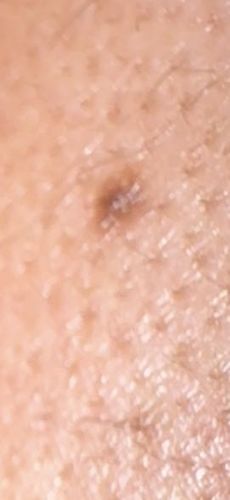
Community identification
Scabies Mite (speculative due to image quality)
Sarcoptes scabiei var. hominis
- Order & Family
- Order: Sarcoptiformes, Family: Sarcoptidae
- Size
- Microscopic; approximately 0.3 mm to 0.45 mm long (adult female). Barely visible to the naked eye as a tiny speck.
Natural Habitat
The epidermis (outer layer) of human skin, particularly in areas like finger webs, wrists, elbows, and irregular folds.
Diet & Feeding
Feeds on tissue fluids and dissolved human skin cells as it burrows through the epidermis.
Behavior Patterns
Mites burrow into the upper layer of the skin to live and deposit eggs. The burrowing creates intense itching, usually worse at night. The tracks can sometimes be seen as tiny, raised, grayish-white or skin-colored lines.
Risks & Benefits
Risks: Causes scabies, a highly contagious skin infestation causing severe itching and a pimple-like rash. Scratching can lead to secondary bacterial infections like impetigo. Not a vector for other diseases, but highly transmissible through direct skin-to-skin contact.