
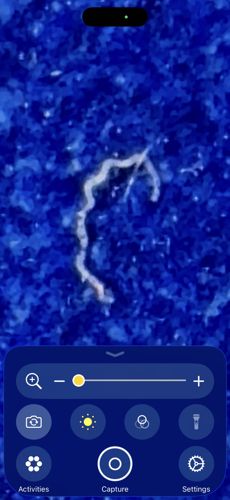
Nematode (Roundworm)
Nematoda (Phylum)
- Order & Family
- Various orders and families within parts of the Phylum Nematoda (e.g., family Rhabditidae)
- Size
- Microscopic to barely visible; most free-living species range from 0.1 mm to 2.5 mm in length.
Natural Habitat
Extremely diverse; found in almost every ecosystem on Earth, including soil, marine and freshwater environments, and as parasites in plants and animals. This specific specimen is likely a soil-dwelling or detritus-feeding non-parasitic variety found in moisture.
Diet & Feeding
Highly varied depending on the species; many are bacterivores (eating bacteria), fungivores (eating fungi), or predators of other small microorganisms. Others are parasitic to plants or animals.
Behavior Patterns
They exhibit a characteristic trashing or S-shaped swimming motion due to having only longitudinal muscles. They require a film of water to move and are often found in decaying organic matter or moist soil samples.
Risks & Benefits
Benefits: Essential for nutrient cycling and decomposition in soil ecosystems; beneficial nematodes are used in gardening to kill pests. Risks: Some species are parasitic and can cause diseases in humans (e.g., hookworms, pinworms) or damage agricultural crops (e.g., root-knot nematodes).