
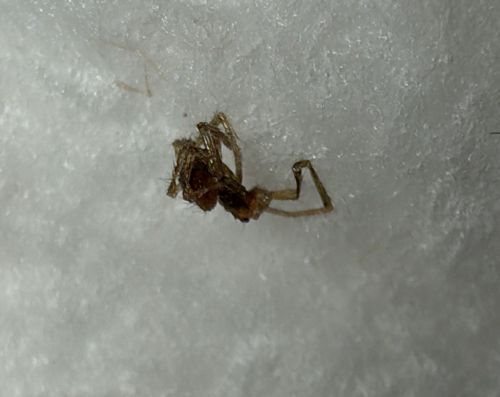
Common House Spider (or similar Cobweb Spider)
Parasteatoda tepidariorum (most likely candidate)
- Order & Family
- Order: Araneae, Family: Theridiidae
- Size
- Females are typically 5–6 mm in body length (excluding legs), while males are smaller, usually around 3–4 mm.
Natural Habitat
Extremely common in and around human dwellings (basements, corners of rooms, garages, sheds), as well as in gardens and under rocks.
Diet & Feeding
Carnivorous; feeds primarily on small insects like flies, mosquitoes, ants, and sometimes other spiders that get trapped in their messy webs.
Behavior Patterns
Known for building tangled, messy cobwebs in corners. They are generally passive and will retreat if disturbed. This specimen appears to be dead and shriveled, exhibiting the typical 'death curl' where legs are pulled inward.
Risks & Benefits
Benefits: Excellent pest control, eating many household nuisance insects. Risks: Generally harmless to humans. They are not aggressive and rarely bite; their venom is not medically significant to humans, causing only minor localized pain if a bite occurs.