
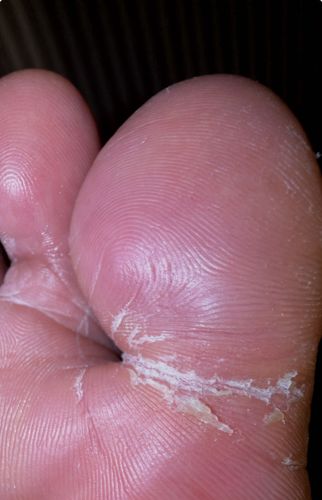
Community identification
Scabies Mite (burrow)
Sarcoptes scabiei
- Order & Family
- Order: Sarcoptiformes, Family: Sarcoptidae
- Size
- Microscopic; females are approx. 0.3-0.45 mm long, males are smaller about 0.2-0.24 mm.
Natural Habitat
The epidermis (outer layer) of skin in humans and other mammals; they do not survive long away from a host.
Diet & Feeding
Feeds on human skin cells and lymph fluid while burrowing.
Behavior Patterns
The image shows the characteristic 'burrow' or tunnel lines on the skin (specifically the sole of the foot). Female mites tunnel into the stratum corneum to deposit eggs and feces, causing intense itching and an allergic reaction.
Risks & Benefits
Risk: Causes Scabies, a highly contagious skin infestation characterized by severe itching (especially at night) and a pimple-like rash. Benefit: None to humans or the ecosystem; purely a parasitic pest.