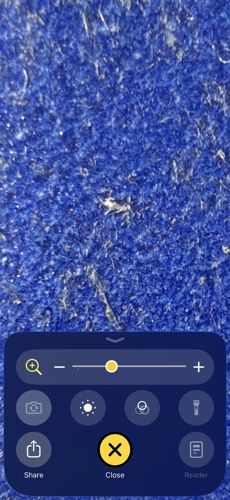
There is insufficient detail for a positive ID, but it resembles a Dust Mite or possibly a Springtail/Booklouse.
Scientific Name: Likely Dermatophagoides spp. (if dust mite) or Order Psocoptera (if booklouse)
Order & Family: Order: Sarcoptiformes / Family: Pyroglyphidae (Dust Mites) OR Order: Psocoptera (Booklice)
Size: Microscopic to barely visible; typically 0.2 to 1 mm in length.
Natural Habitat
Typically found in indoor environments, specifically in fabrics, carpets, bedding, and mattresses where dust accumulates.
Diet & Feeding
Primarily dead skin cells shed by humans and pets, as well as fungal spores and microscopic mold.
Behavior Patterns
They thrive in humid environments and are mostly stationary scavengers. They do not bite or sting but are known to crawl deep into fibers.
Risks & Benefits
Risks: A common allergen source; their feces and body fragments can trigger asthma and allergic reactions. Benefits: They help break down organic waste like dead skin cells.
Identified on: 3/9/2026