
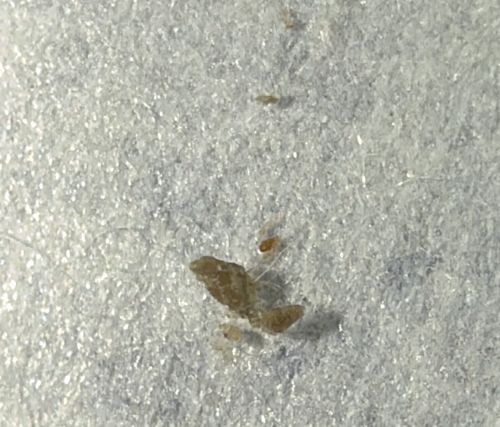
Booklouse (or Psocid)
Liposcelis spp. (specifically likely belonging to the family Liposcelididae)
- Order & Family
- Order: Psocodea (formerly Psocoptera), Family: Liposcelididae
- Size
- Very tiny, typically less than 1mm to 2mm (roughly 1/25 to 1/13 inch) in length.
Natural Habitat
Found in warm, high-humidity environments indoors, such as basements, bathrooms, libraries, and food pantries. They thrive in damp, moldy areas, old papers, wallpaper paste, and stored grains.
Diet & Feeding
They feed on microscopic molds, fungi, starch-based materials (like book bindings, glue, wallpaper paste), stored grains, dried milk, and dead insects.
Behavior Patterns
Booklice are wingless and run rapidly/jerkily rather than fly. They do not bite. They reproduce parthenogenetically (without fertilization) in warm conditions and can build up large populations quickly if humidity is high.
Risks & Benefits
Risks: They are a nuisance pest that contaminates stored food and damages books or wallpaper by eating the glue/starch. They can induce allergic reactions in sensitive individuals due to dead bodies and waste. Benefits: They act as scavengers cleaning up microscopic mold, indicating moisture issues in a home.