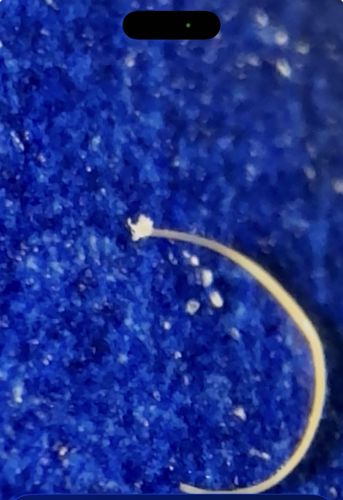
Human Hair Strand (with Follicle/Root Sheath)
Scientific Name: Homo sapiens (hair)
Order & Family: Order: Primates, Family: Hominidae (part of the integumentary system)
Size: Thickness ranges from 17 to 180 micrometers; length varies greatly based on location and grooming.
Natural Habitat
Typically found on the scalp or body of humans; frequently falls onto clothing, furniture, or floors.
Diet & Feeding
Non-living tissue composed primarily of keratin; does not eat.
Behavior Patterns
Hair grows in cycles (anagen, catagen, telogen) and naturally sheds. The white bulb visible at one end is likely the root sheath, indicating the hair was pulled or shed during the growth cycle.
Risks & Benefits
Benefits: Provides insulation and protection for the body. Risks: No health risk, though can sometimes be mistaken for parasites or worms by those unfamiliar with microscopic views.
Identified on: 2/11/2026