
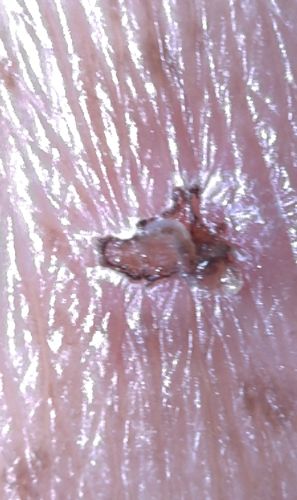
Scabies Mite
Sarcoptes scabiei var. hominis
- Order & Family
- Order: Sarcoptiformes, Family: Sarcoptidae
- Size
- Microscopic; females are typically 0.30–0.45 mm long and 0.25–0.35 mm wide, while males are slightly smaller.
Natural Habitat
The epidermis (upper layer) of human skin, particularly in warm, moist folds such as between fingers, wrists, armpits, and groin areas.
Diet & Feeding
They feed on human skin cells and shallow lymph fluid found within the epidermis.
Behavior Patterns
Adult females burrow into the upper layer of the skin to lay eggs, creating visible, thread-like tunnels (as seen in the image). The life cycle involves egg, larva, nymph, and adult stages, entirely occurring on the host.
Risks & Benefits
Risks: It is a parasitic infestation causing intense itching (especially at night) and a pimple-like rash. Scratching can lead to secondary bacterial infections like impetigo or cellulitis. It is highly contagious through direct skin-to-skin contact. Benefits: None; it is a parasitic pest.