
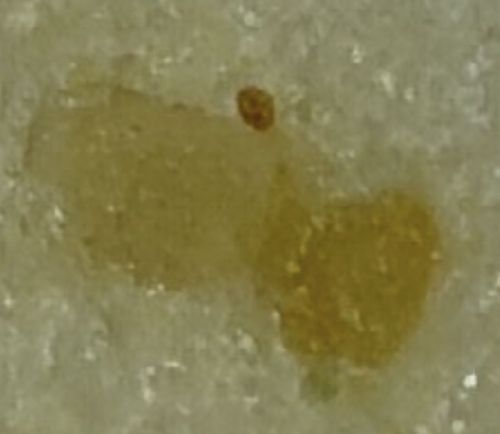
Head Louse (specifically a nit or egg casing)
Pediculus humanus capitis
- Order & Family
- Order: Phthiraptera, Family: Pediculidae
- Size
- Nits are approximately 0.8 mm by 0.3 mm (oval shaped). Adult lice are about 2–3 mm long (roughly the size of a sesame seed).
Natural Habitat
The human scalp, particularly behind the ears and near the neckline at the back of the head. Louse eggs (nits) are cemented firmly to individual hair shafts close to the scalp.
Diet & Feeding
Hematophagous (feed exclusively on human blood obtained from the scalp).
Behavior Patterns
Lice cannot fly or jump; they move by crawling. They cement their eggs (nits) to hair shafts. The life cycle consists of three stages: egg (nit), nymph, and adult. They require human blood to survive and will die within 1-2 days if separated from the host.
Risks & Benefits
Risks include intense itching (pruritus) caused by an allergic reaction to louse saliva, sleep disturbance due to itching, and potential secondary bacterial skin infections from scratching. They are generally not known to transmit disease, unlike body lice. There are no known ecological benefits.