
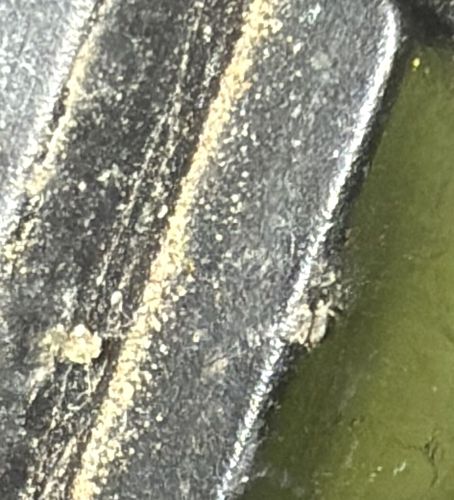
Community identification
Spider Mite (likely Two-spotted Spider Mite)
Tetranychus urticae
- Order & Family
- Order: Trombidiformes; Family: Tetranychidae
- Size
- Approximately 0.4 to 0.6 mm in length (barely visible to the naked eye).
Natural Habitat
Found worldwide on hundreds of species of plants, often on the undersides of leaves in greenhouses, gardens, and indoor houseplants, especially in hot, dry conditions.
Diet & Feeding
Herbivorous sap-suckers; they use needle-like mouthparts to pierce plant cells and suck out the contents, causing stippling and yellowing of leaves.
Behavior Patterns
They live in colonies, often creating fine webbing (silk) to protect themselves and their eggs. They reproduce rapidly in warm weather, with populations exploding in just a few days.
Risks & Benefits
Risks: Major agricultural and horticultural pest capable of killing plants by destroying foliage. Benefits: Serve as a food source for beneficial predatory mites and insects like lacewings and ladybugs.