
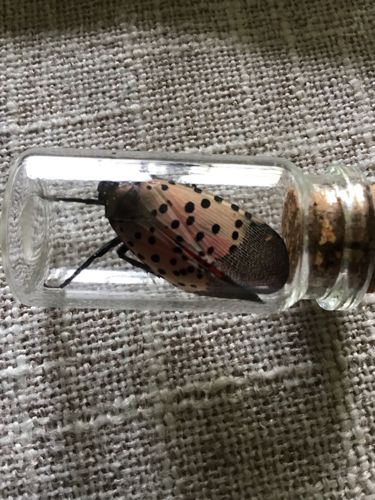
Spotted Lanternfly
Lycorma delicatula
- Order & Family
- Order: Hemiptera, Family: Fulgoridae
- Size
- Adults typically measure about 2.5 cm (1 inch) in length and 1.2 cm (0.5 inch) in width. Nymphs start much smaller, around 0.6 cm (0.25 inches), and grow with each instar.
Natural Habitat
Originally from China, India, and Vietnam, the Spotted Lanternfly has become an invasive species in several countries, including the United States. In invaded areas, they can be found in vineyards, orchards, forests, urban and suburban areas, and anywhere their host plants are present. They often congregate on the trunks and branches of trees.
Diet & Feeding
The Spotted Lanternfly is a planthopper that feeds on a wide variety of plants, including agricultural crops, ornamental plants, and trees. Its preferred host is the Tree of Heaven (Ailanthus altissima), but it also feeds on grapevines, fruit trees (apple, peach, cherry), hops, walnuts, and maples, among many others. Both nymphs and adults feed on the sap of these plants.
Behavior Patterns
Spotted Lanternflies are known for their strong jumping ability. Adults can also fly, though they are not strong flyers. They undergo incomplete metamorphosis, with nymphs molting through several instars before becoming adults. They are an invasive species, spreading rapidly by laying egg masses on various surfaces including trees, outdoor furniture, vehicles, and even stones. The nymphs and adults feed by piercing the plant tissue with their mouthparts and sucking out the sap. During feeding, they excrete a sugary substance called honeydew, which can promote the growth of sooty mold.
Risks & Benefits
Potential Risks: The Spotted Lanternfly poses a significant threat to agriculture and forestry. Their feeding weakens plants and can lead to decreased yields, defoliation, and even plant death, particularly for grapevines, fruit trees, and various hardwood trees. The honeydew they excrete causes sooty mold to grow, which can reduce photosynthesis in plants and make outdoor surfaces sticky and unsightly. They are considered a serious invasive pest. Potential Benefits: There are no known direct benefits of the Spotted Lanternfly in invaded ecosystems; rather, they are a damaging pest.