
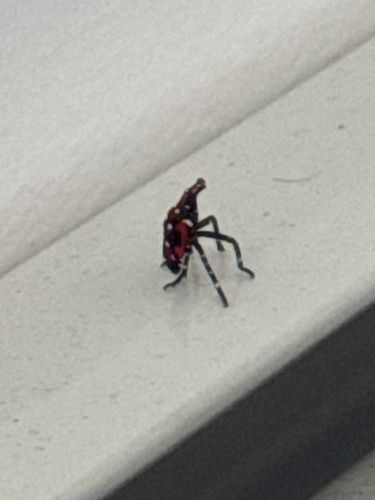
Spotted Lanternfly (Fourth Instar Nymph)
Lycorma delicatula
- Order & Family
- Order: Hemiptera, Family: Fulgoridae
- Size
- Fourth instar nymphs are typically around 1/2 inch (12-14 mm) long.
Natural Habitat
Originating from China, Vietnam, and India, the Spotted Lanternfly is an invasive species in North America and Korea. They are found in vineyards, orchards, forests, and suburban and urban environments, wherever their host plants are present. They often aggregate on preferred host trees like Tree of Heaven, maples, and fruit trees.
Diet & Feeding
The Spotted Lanternfly is a planthopper that feeds on the sap of a wide variety of plants, piercing the plant tissues with their mouthparts and sucking out the phloem sap. While they prefer Tree of Heaven (Ailanthus altissima), they are known to feed on over 70 species of plants, including important agricultural crops like grapes, apples, hops, and hardwoods such as maple, oak, and walnut.
Behavior Patterns
Spotted Lanternfly nymphs undergo several instar stages, with the depicted instar typically being the final nymphal stage before adulthood. They are active during the day, feeding on plant sap. They are known to climb up host plants and are quite mobile. When disturbed, they may hop or quickly move away. Adults are strong flyers but often are observed hopping or walking. They excrete large amounts of honeydew which can lead to sooty mold growth on affected plants.
Risks & Benefits
The Spotted Lanternfly is a significant invasive pest with no known benefits in the ecosystems it has invaded. Risks include severe damage to agricultural crops (especially grapevines and fruit trees), ornamental plants, and forest trees. Their feeding weakens plants and can lead to reduced yields or plant death. The honeydew they excrete promotes the growth of sooty mold, which can blacken plants, reduce photosynthesis, and decrease crop value. While not harmful to humans directly (they do not bite or sting), their infestations can be a nuisance and cause economic losses.