
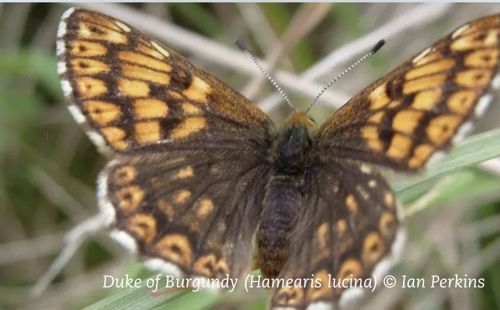
Community identification
Duke of Burgundy
Hamearis lucina
- Order & Family
- Lepidoptera, Riodinidae
- Size
- Wingspan typically between 29mm and 32mm.
Natural Habitat
Found in ancient woodland clearings, scrubby grasslands, and chalk downland with patches of Primula plants.
Diet & Feeding
Caterpillars feed on Primrose (Primula vulgaris) and Cowslip (Primula veris). Adults feed on nectar from flowers such as buttercups and daisies.
Behavior Patterns
Males are highly territorial and perch on shrubs to intercept passing females or drive away rivals. They exhibit a fast, skipping flight pattern. They are univoltine, appearing mostly in May and June.
Risks & Benefits
No risk to humans. They are an indicator species for well-managed woodland and grassland ecosystems; however, they are a conservation priority due to declining populations.