
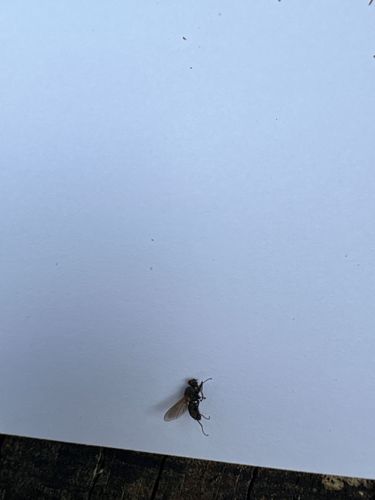
Fly (likely a Muscidae family member, e.g., House Fly or a related species)
Musca domestica (common house fly example, but exact species cannot be determined from image)
- Order & Family
- Order: Diptera, Family: Muscidae (or potentially another family within Diptera, but Muscidae is a common possibility for this appearance)
- Size
- Typically 4-15 mm (depending on the specific species, house flies are around 6-7 mm)
Natural Habitat
Flies are ubiquitous and can be found in nearly every terrestrial habitat, especially where there is decaying organic matter for their larvae or food sources for adults. This includes urban, rural, and natural environments.
Diet & Feeding
Adult flies have diverse diets depending on the species; many feed on decaying organic matter, nectar, or sugary substances. Larvae (maggots) often feed on decaying plant or animal matter, carrion, or dung.
Behavior Patterns
Flies are typically active during the day. Their flight patterns can be erratic. Larvae (maggots) develop in decaying organic matter, while adults are free-flying and primarily focused on feeding and reproduction. Many species are attracted to light.
Risks & Benefits
Risks: Many fly species are vectors for diseases and can transmit pathogens to humans and animals, cause economic damage to agriculture, and be pests. Benefits: Some flies are important pollinators, decomposers (helping to break down organic waste), and a food source for other animals. Forensic entomologists use blow fly larvae for estimating time of death.