
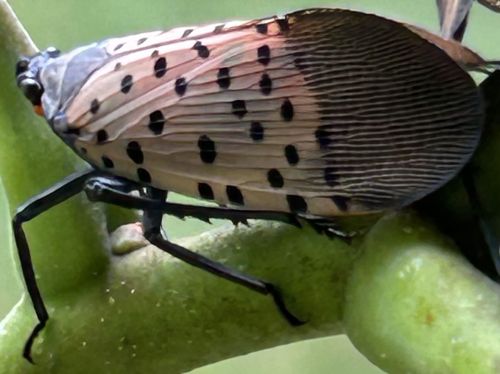
Spotted Lanternfly
Lycorma delicatula
- Order & Family
- Order: Hemiptera, Family: Fulgoridae
- Size
- Adults typically range from 2.0 to 2.5 cm (0.8 to 1.0 inch) in length and have a wingspan of about 4 to 5 cm (1.6 to 2.0 inches).
Natural Habitat
Native to China, India, and Vietnam, the Spotted Lanternfly is an invasive species in many parts of the world, including the United States (primarily in the Mid-Atlantic region). They are often found in vineyards, orchards, forests, and suburban areas, preferring environments with their host plants, especially Tree of Heaven.
Diet & Feeding
Spotted Lanternflies are sap-feeding insects that primarily feed on the phloem of over 100 different plant species. Preferred hosts include Tree of Heaven (Ailanthus altissima), grapevines, maples, walnuts, and fruit trees. They use their piercing-sucking mouthparts to extract plant sap.
Behavior Patterns
Spotted Lanternflies undergo incomplete metamorphosis, having three main life stages: egg, nymph, and adult. They are known for their strong jumping ability and for excreting a sticky substance called honeydew, which can promote the growth of sooty mold. Adults are typically seen from July to December.
Risks & Benefits
Risks: Spotted Lanternflies are a significant agricultural and ecological pest. Their feeding can damage and kill host plants, especially grapevines, fruit trees, and hops, leading to substantial economic losses. The honeydew they excrete attracts other insects and promotes the growth of black sooty mold, which can cover plants, reducing photosynthesis and aesthetic value. Benefits: There are no known benefits of the Spotted Lanternfly in invaded ecosystems; they are an invasive species.