
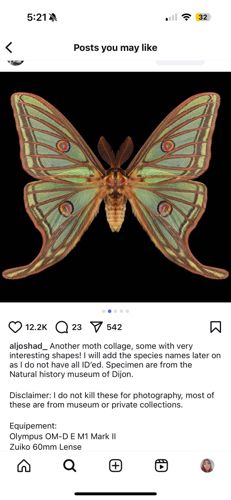
Moon Moth (likely an Actias species, possibly Chinese Moon Moth or a closely related species)
Actias (species determination requires more detail, but could be Actias selene, Actias artemis, or another Actias species)
- Order & Family
- Order: Lepidoptera, Family: Saturniidae (giant silk moths and royal moths)
- Size
- Large moths, with wingspans typically ranging from 10 to 15 cm (4 to 6 inches) or even larger, depending on the specific species.
Natural Habitat
Found in forests, woodlands, and areas with suitable host plants for their larvae. Distribution varies by species, but many are native to Asia.
Diet & Feeding
Adult moon moths typically do not feed as they lack functional mouthparts. They rely on energy reserves stored during their larval stage. Larvae (caterpillars) are herbivorous, feeding on the leaves of various trees such as oak, birch, willow, sweetgum, and alder.
Behavior Patterns
Adults are nocturnal and are attracted to light. They have a relatively short adult lifespan (often less than two weeks) during which their primary goal is reproduction. Larvae (caterpillars) are voracious feeders on specific host plants.
Risks & Benefits
Generally beneficial as part of the ecosystem's food web. Their larvae can be a food source for birds and other predators. As pollinators, they may play a minor role, though their primary function as adults is reproduction. They pose no direct risks to humans; they do not bite or sting.