
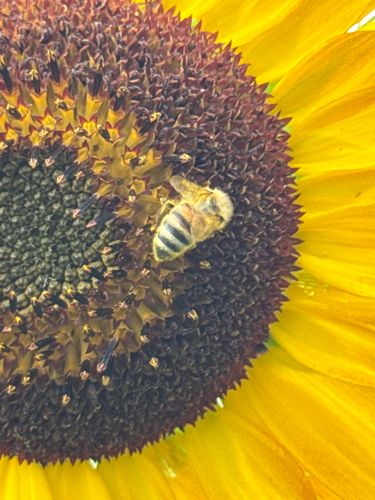
European Honey Bee
Apis mellifera
- Order & Family
- Order: Hymenoptera, Family: Apidae
- Size
- Worker bees are typically 10-15 mm (0.4-0.6 inches) long.
Natural Habitat
Honey bees are semi-domesticated and can be found globally in diverse environments where flowering plants are abundant. They typically build nests in hollow trees, rock crevices, or man-made hives.
Diet & Feeding
Honey bees primarily feed on nectar, which provides carbohydrates (energy), and pollen, which supplies proteins, vitamins, minerals, and fats. They also collect water and propolis (tree resin).
Behavior Patterns
Honey bees are social insects living in highly organized colonies that can number tens of thousands of individuals. They communicate through complex dances (e.g., waggle dance) to indicate the location of food sources. Worker bees forage for nectar and pollen, build and maintain the hive, and care for the queen and young. The queen bee is responsible for laying eggs, and drones (male bees) mate with the queen.
Risks & Benefits
Benefits: Honey bees are crucial pollinators for a vast number of agricultural crops and wild plants, contributing significantly to food production and ecosystem health. They also produce honey, beeswax, propolis, and royal jelly, which have various human uses. Risks: Their stings can be painful and cause allergic reactions (anaphylaxis) in sensitive individuals. Varroa mites and colony collapse disorder (CCD) are significant threats to honey bee populations.