
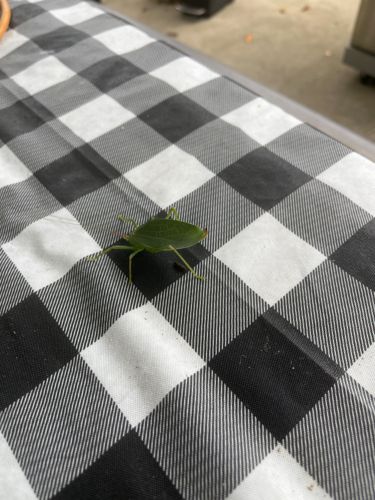
Katydid
Tettigoniidae (Family name, as specific genus/species is hard to determine from the image)
- Order & Family
- Order: Orthoptera, Family: Tettigoniidae
- Size
- Typically 1 to 5 inches (2.5 to 13 cm) in length, though some tropical species can be larger.
Natural Habitat
Katydids are found globally in tropical and temperate regions, primarily in trees, shrubs, tall grasses, and other dense vegetation in forests, grasslands, and gardens. Their green coloration provides excellent camouflage in these environments.
Diet & Feeding
Most katydids are herbivorous, feeding on leaves, flowers, and fruits of various plants. Some species are omnivorous, also consuming small insects, eggs, or carrion. A few species are predatory.
Behavior Patterns
Katydids are primarily nocturnal, hence their characteristic chirping or "singing" at night, which is produced by the males rubbing their forewings together (stridulation) to attract mates. They are generally solitary and well-camouflaged, tending to remain still during the day to avoid predators. Some species are migratory.
Risks & Benefits
Risks: While generally harmless to humans, large populations can cause damage to agricultural crops and garden plants due to their herbivorous diet. Benefits: They serve as a food source for various predators (birds, bats, reptiles) and can contribute to seed dispersal incidentally. They are also indicators of healthy ecosystems.