
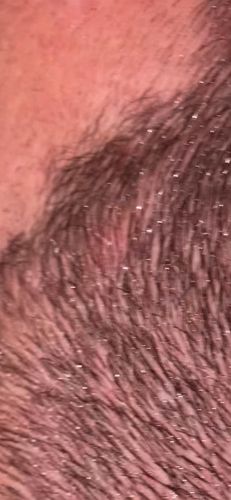
Community identification
Pubic Louse (and eggs/nits)
Pthirus pubis
- Order & Family
- Order: Psocodea (formerly Phthiraptera), Family: Pthiridae
- Size
- Adults are approximately 1.1–1.8 mm; nits (eggs) are much smaller and appear as tiny white dots attached to hair shafts.
Natural Habitat
Found exclusively on human hosts, primarily in the pubic hair or other coarse body hair like chest hair, beard, or eyebrows.
Diet & Feeding
Obligate hematophagous: they feed exclusively on human blood throughout all life stages.
Behavior Patterns
They move slowly and grip hair shafts with specialized crab-like claws. They cannot jump or fly. They lay eggs (nits) on the hair shaft near the skin, which hatch in about 6-10 days.
Risks & Benefits
Risks: Causes intense itching (pruritus) due to an allergic reaction to their saliva; can cause blue-gray skin spots (maculae caeruleae). They can be spread through close physical contact. There are no ecological benefits as they are parasitic.