
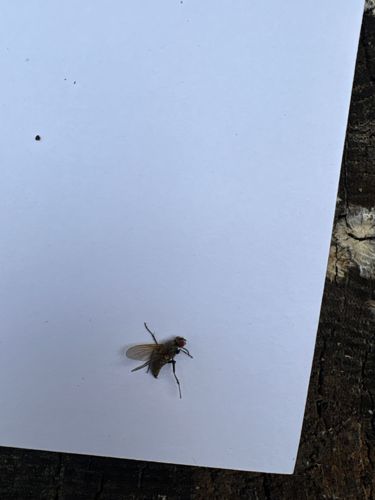
House Fly
Musca domestica
- Order & Family
- Order: Diptera, Family: Muscidae (specifically Musca domestica)
- Size
- 6-7 mm (0.24-0.28 inches) in length, with a wingspan of 13-15 mm (0.51-0.59 inches)
Natural Habitat
House flies are ubiquitous and found worldwide. They prefer environments where organic decaying matter is present, such as near garbage, compost piles, animal feces, and human dwellings. They are common in residential, agricultural, and urban areas.
Diet & Feeding
Adult house flies feed on a variety of liquid or semi-liquid substances, including decaying organic matter, animal waste, human food, and sugary liquids. They regurgitate digestive juices onto solid food to liquefy it before ingesting.
Behavior Patterns
House flies undergo complete metamorphosis, with egg, larval (maggot), pupal, and adult stages. Females lay eggs in decaying organic matter. Larvae feed and grow rapidly, then pupate. Adults are active during the day, resting at night. They are known for their erratic flight patterns and frequent landing.
Risks & Benefits
Risks: House flies are significant vectors of disease-causing pathogens, including bacteria (e.g., E. coli, Salmonella), viruses, and parasites. They can transmit diseases like typhoid fever, cholera, dysentery, and food poisoning by carrying pathogens on their bodies and in their excretions. Benefits: In natural ecosystems, house flies and their larvae can contribute to the decomposition of organic matter.