
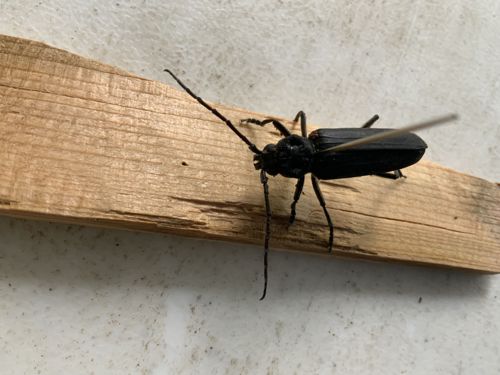
Black Arches Longhorn Beetle, or sometimes referred to as a species of Black Spruce Borer
Possibly a species within the genus Monochamus, such as Monochamus scutellatus (White-spotted Sawyer Beetle) or another similar longhorn beetle. Without more specific visual cues or geographical information, a definitive species identification is difficult, but it strongly resembles a Monochamus species due to its robust body, long antennae, and overall black coloration.
- Order & Family
- Order: Coleoptera, Family: Cerambycidae (Longhorn Beetles)
- Size
- Typically ranges from 15 mm to 35 mm (0.6 to 1.4 inches) in body length, excluding antennae.
Natural Habitat
Forests, woodlands, and areas with an abundance of host trees. Larval stages are found within the wood of trees, both living and recently cut or stressed.
Diet & Feeding
Adults typically feed on tree sap, pollen, or may not feed at all (non-feeding adults). Larvae are xylophagous, meaning they bore into and feed on the wood of various deciduous or coniferous trees, depending on the specific species. Given its appearance, it is likely wood-boring.
Behavior Patterns
Adults are active flyers, especially at dusk and during the night, and are attracted to lights. They are crepuscular or nocturnal. Females lay eggs in crevices of bark on living trees or freshly cut wood. Larvae bore into the wood, creating tunnels, and can take several years to develop depending on conditions. The presence of emerging adults indicates larval development within wood.
Risks & Benefits
Potential risks include damage to timber and lumber if infestations are severe, as the larvae bore into wood, reducing its structural integrity and commercial value. In natural ecosystems, they play a role in decomposition and nutrient cycling by breaking down dead or decaying wood. Benefits are generally limited in human-centric terms, but they are part of the natural forest ecosystem.