
Community identification
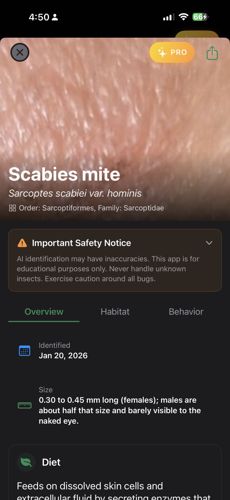
Scabies mite
Sarcoptes scabiei var. hominis
- Order & Family
- Order: Sarcoptiformes, Family: Sarcoptidae
- Size
- 0.30 to 0.45 mm long (females); males are approximately half that size and barely visible to the naked eye.
Natural Habitat
The epidermis of human skin, specifically the stratum corneum.
Diet & Feeding
Feeds on dissolved skin cells and extracellular fluid by secreting enzymes that degrade host tissue.
Behavior Patterns
Female mites burrow into the skin to lay eggs. They are most active at night, which often leads to increased itching for the host. The life cycle involves egg, larva, nymph, and adult stages, occurring entirely on the host.
Risks & Benefits
Causes scabies, a contagious skin infestation characterized by intense itching and a pimple-like rash. It is a significant public health risk as it spreads through direct, prolonged skin-to-skin contact. There are no known benefits to humans or ecosystems.