
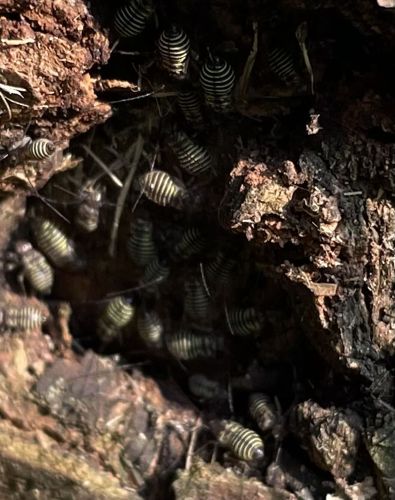
Soldier Beetle Larvae or possibly Darkling Beetle Larvae
Varies significantly by species; some examples for Soldier Beetles include Cantharis spp. or Rhagonycha spp. For Darkling Beetles, Tenebrio spp. is common.
- Order & Family
- Order: Coleoptera (Beetles), Family: Likely Cantharidae (Soldier Beetles) or Tenebrionidae (Darkling Beetles), though other families are possible given the larval form alone.
- Size
- Larvae of these types typically range from 10 mm to 30 mm (0.4 to 1.2 inches) in length, varying by species and stage of development.
Natural Habitat
Based on the image showing them in what appears to be decaying wood or under bark, their habitat would be moist, decaying wood, logs, stumps, or forest litter. They require damp environments to thrive.
Diet & Feeding
The diet depends on the specific species, but many beetle larvae, especially those found in decaying wood like these appear to be, are detritivores, feeding on decaying organic matter, fungi, or dead wood. Some can be predatory on other small invertebrates in the substrate.
Behavior Patterns
These are the larval stage of a beetle. Larvae are typically grub-like and spend their time feeding and growing, often in decaying wood or soil, before pupating and emerging as adult beetles. They are generally slow-moving. The aggregation seen in the image might be a result of favorable environmental conditions (moisture, food source) within the decaying wood.
Risks & Benefits
Generally, these larvae pose no risk to humans. As detritivores, they are highly beneficial to ecosystems as decomposers, breaking down dead organic matter and returning nutrients to the soil. They play an important role in forest health by aiding in the decomposition of wood.