
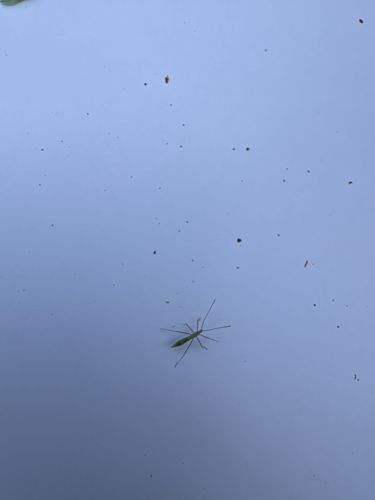
Assassin Bug (likely a species of Damsel Bug or Thread-legged Bug, both closely related to Assassin Bugs due to the slender body and long legs, which resemble those of true assassin bugs and other predatory hemipterans. Given the slender body and very long, delicate legs, it strongly resembles a Thread-legged Bug, which are a subfamily of assassin bugs).
Reduviidae family members exhibit a wide range of genera and species. Without a clearer, more detailed image, a specific scientific name beyond the family is difficult to pinpoint. It might be in the genus Zelus if it's a typical assassin bug, or a genus within Emesinae (like Emesa or Stenolemus) if it's a thread-legged bug, or Nabis if a damsel bug.
- Order & Family
- Order: Hemiptera, Family: Reduviidae (Assassin Bugs), likely Subfamily Emesinae (Thread-legged Bugs) or Nabidae (Damsel Bugs).
- Size
- Varies by species. Assassin bugs range from small (a few millimeters) to quite large (up to 40 mm, about 1.5 inches). The individual in the image appears to be on the smaller side, likely in the 10-20 mm (0.4-0.8 inches) range, which is common for many predatory bugs like damsel bugs or slender assassin bugs.
Natural Habitat
Widely varied. Assassin bugs can be found in diverse habitats, including gardens, agricultural fields, forests, grasslands, and even desert environments. They are often found on vegetation where their prey is abundant. Thread-legged bugs, specifically, are often found in more sheltered areas like under eaves, in spider webs (to prey on spiders), or on plants.
Diet & Feeding
Predatory. Assassin bugs feed on a wide variety of other insects and arthropods, including aphids, leafhoppers, caterpillars, flies, and sometimes even other bugs larger than themselves. They have a piercing-sucking mouthpart (rostrum) which they use to inject venom into their prey, paralyzing it, and then suck out the liquefied внутренних.
Behavior Patterns
Assassin bugs are generally solitary predators. They are known for their ambush hunting technique, often waiting for prey to come within striking distance. Some species use camouflage to blend into their surroundings, while others may mimic their prey or even use sticky traps (like some ambrosia bugs species). Most are nocturnal, but some are active during the day. Mating typically involves direct copulation, and females lay eggs, often in clusters, on plants or in protected areas. The nymphs go through several instars before reaching adulthood.
Risks & Benefits
Benefits: Assassin bugs are highly beneficial insects, especially in agriculture and gardens, as they are effective natural predators that help control populations of many pest insects. They are considered valuable biological control agents, reducing the need for chemical pesticides. Risks: While generally not aggressive towards humans, some larger species of assassin bugs can deliver a painful bite if provoked or handled carelessly. The bite is not venomous to humans but can be quite irritating, similar to a bee sting. There are some species, like the 'kissing bugs' (Triatominae subfamily, also assassin bugs), that are vectors for Chagas disease in certain parts of the world, but the bug in the image does not appear to be a 'kissing bug'.