
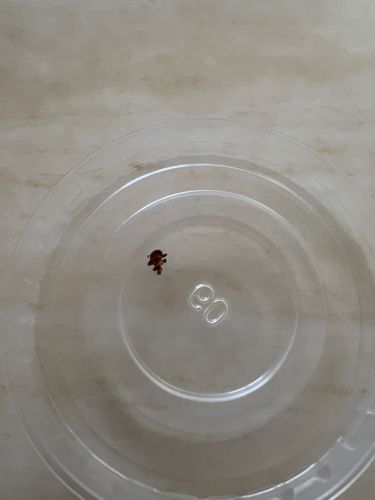
Tick (likely a hard tick)
Too difficult to determine from the image alone, as various species exist. Examples include *Ixodes scapularis* (deer tick), *Amblyomma americanum* (Lone Star tick), *Dermacentor variabilis* (American dog tick).
- Order & Family
- Order: Ixodida (often still referred to as Acarina or Parasitiformes) Family: Ixodidae (Hard Ticks) or Argasidae (Soft Ticks), based on the visual, it appears to be a hard tick (Ixodidae) due to its defined scutum (dorsal shield).
- Size
- Unfed: 1 mm to 5 mm (0.04 to 0.2 inches). Fed (engorged): can swell up to 10-15 mm (0.4 to 0.6 inches) or more depending on species and amount of blood meal.
Natural Habitat
Widely distributed in many terrestrial habitats, particularly in wooded areas, tall grasses, brushy areas, and leaf litter. They are often found in areas frequented by their hosts.
Diet & Feeding
Blood of vertebrates (mammals, birds, reptiles, amphibians).
Behavior Patterns
Ticks are obligate parasites and spend most of their lives off-host, waiting for a suitable host. They detect hosts by sensing breath, body odors, body heat, moisture, and vibrations. They can crawl onto vegetation and wait for a passing host, a behavior known as 'questing.' Once on a host, they typically crawl to a protected area to attach and feed for several days. After feeding, females drop off to lay eggs.
Risks & Benefits
Risks: Ticks are significant vectors of various pathogens, causing diseases in humans and animals, including Lyme disease, Rocky Mountain spotted fever, ehrlichiosis, anaplasmosis, babesiosis, and tularemia. Their bites can also cause local irritation or allergic reactions. Benefits: In some ecological contexts, ticks can be a food source for certain predators like birds and ants, and they play a role in the natural food web, although this benefit is often outweighed by their vectorial capacity for disease.