
Community identification
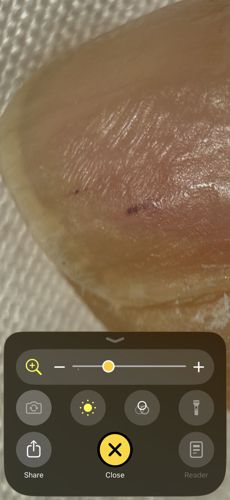
None (Biological splinter hemorrhage)
None (Subungual splinter hemorrhage)
- Order & Family
- None (Dermatological/Clinical condition)
- Size
- 1 to 3 millimeters in length; very thin and linear.
Natural Habitat
The nail bed of human fingernails or toenails.
Diet & Feeding
Not applicable as this is a medical condition (minor bleeding), not an organism.
Behavior Patterns
These appear as small, thin, vertical reddish-brown lines under the nail. They are caused by damaged capillaries in the nail bed. They do not move and grow out with the nail plate over several weeks.
Risks & Benefits
Usually harmless and caused by local trauma (bumping the nail). In rare cases, multiple splinter hemorrhages can be associated with underlying conditions like endocarditis or psoriasis. They offer no ecological benefits.