
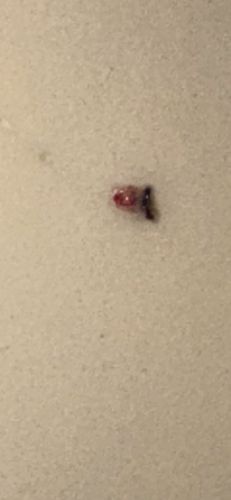
Tick (likely partially crushed and engorged)
Too indistinct to determine species, but falls under the suborder Ixodida.
- Order & Family
- Order: Ixodida; Family: Ixodidae (hard ticks) or Argasidae (soft ticks). Given the apparent engorgement and shape, it's likely a hard tick.
- Size
- Before feeding, ticks can range from less than 1 mm (larvae and nymphs) to several millimeters (adults). When engorged with blood, they can swell considerably, reaching up to 10-15 mm in length, depending on the species.
Natural Habitat
Ticks are typically found in grassy, brushy, or wooded areas, including forests, tall grass, leaf litter, and even urban parks and gardens. They quest on vegetation, waiting for a host.
Diet & Feeding
Strictly hematophagous (blood-feeding) at all life stages (larva, nymph, adult). They feed on the blood of mammals, birds, and sometimes reptiles and amphibians.
Behavior Patterns
As a crushed specimen, specific behaviors cannot be observed. However, adult ticks typically quest for hosts by waiting on vegetation and latching on when an animal or human passes by. Once attached, they feed for several days until engorged. Larvae and nymphs also feed on blood.
Risks & Benefits
Risks: Ticks are significant vectors of various pathogens, transmitting diseases such as Lyme disease, Rocky Mountain spotted fever, anaplasmosis, babesiosis, ehrlichiosis, and tularemia to humans and animals. Their bites can also cause localized irritation or allergic reactions. Benefits: Ticks generally offer no direct benefits to humans and are primarily known for their disease transmission capabilities. In ecosystems, they can be a food source for some predators, though this is a minor role.