
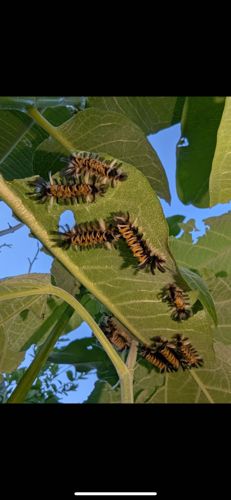
Tussock Moth Caterpillar (likely Orgyia series, possibly White-marked Tussock Moth or similar species)
Orgyia spp. (species indeterminate from image alone, but morphology is consistent with this genus)
- Order & Family
- Lepidoptera (Order), Erebidae (Family) - specifically within the Lymantriinae subfamily (Tussock Moths).
- Size
- Typically 2.5 to 3.5 cm (1 to 1.4 inches) in length when fully grown.
Natural Habitat
Found in forests, woodlands, orchards, and urban/suburban areas where their host plants are present. They are primarily arboreal, living and feeding on trees and shrubs.
Diet & Feeding
Herbivorous. These caterpillars are known to feed on a wide variety of deciduous trees and shrubs, including oak, maple, birch, apple, and various fruit trees. They consume leaves, often capable of defoliating significant portions of a plant.
Behavior Patterns
These caterpillars are often found in groups, especially when young, and feed voraciously on their host plants. As they mature, they may become more solitary. They undergo complete metamorphosis, pupating into a tussock moth.
Risks & Benefits
Potential Risks: Many tussock moth caterpillars, including those in the Orgyia genus, have urticating (stinging) hairs that can cause skin irritation, itching, rashes, or allergic reactions if touched. They can also be considered pests in agriculture or horticulture due to defoliation of trees. Benefits: As part of the ecosystem, they serve as a food source for birds and other predators. The adult moths are pollinators, though generally not considered major ones.