
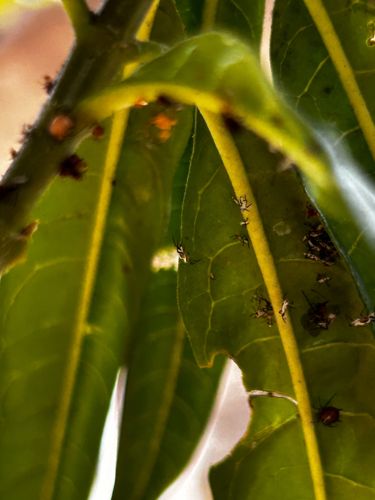
Community identification
Mango leafhopper
Idioscopus nitidulus
- Order & Family
- Hemiptera: Cicadellidae
- Size
- 3 mm to 5 mm in length
Natural Habitat
Commonly found on the undersides of leaves and on the floral panicles of mango trees in tropical and subtropical regions.
Diet & Feeding
Herbivore; they use piercing-sucking mouthparts to feed on plant sap from leaves, shoots, and flower clusters.
Behavior Patterns
They are highly active jumpers and flyers. The insects are often found in large clusters. Females lay eggs inside leaf tissues, and large populations can cause significant damage during the flowering season.
Risks & Benefits
Major agricultural pests; their feeding causes flowers to wither and drop (reducing fruit yield). They also excrete honeydew, which leads to the growth of sooty mold on leaves, hindering photosynthesis. They pose no direct risk to humans.