
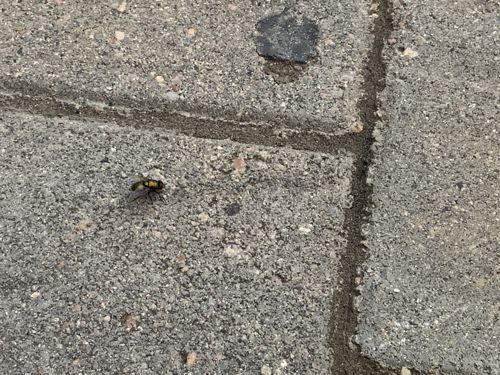
Blow Fly (likely a Green Bottle Fly)
Likely Lucilia sericata or a closely related species within Calliphora or Phaenicia given the greenish/metallic sheen, indicating a 'Green Bottle Fly'. A precise species identification isn't possible from the image alone.
- Order & Family
- Order: Diptera, Family: Calliphoridae
- Size
- Typically 6-12 mm (0.24-0.47 inches) in length.
Natural Habitat
Blow flies are ubiquitous and can be found almost everywhere, especially in areas with decaying organic matter. This includes urban, suburban, and rural environments, near garbage, compost piles, dead animals, and even indoors if food sources are available. The concrete pavement in the image is a common place to observe them resting or moving between food sources.
Diet & Feeding
Adult blow flies feed on a variety of substances including nectar, decaying organic matter (carrion, feces, rotting fruit), and sometimes exudates from wounds or decaying plants. Larvae (maggots) are primarily scavengers, feeding on decaying animal tissue or other organic waste.
Behavior Patterns
Flies are typically very active during the day, especially in warm weather. They are known for their rapid and agile flight. Many species are attracted to decaying organic matter for feeding and breeding. Some species are solitary, while others may aggregate in large numbers.
Risks & Benefits
Potential Risks: Blow flies can be considered pests as they can transmit pathogens (bacteria, viruses) from decaying matter to food consumed by humans or animals, potentially causing foodborne illnesses. Some species can also cause myiasis in animals (and rarely humans), where their larvae infest living tissue. Potential Benefits: They play a crucial role as decomposers in ecosystems, breaking down dead organic material and recycling nutrients. Their maggots are used in forensic entomology to estimate time of death (post-mortem interval). Some species are also used in maggot therapy for wound debridement in medicine.