
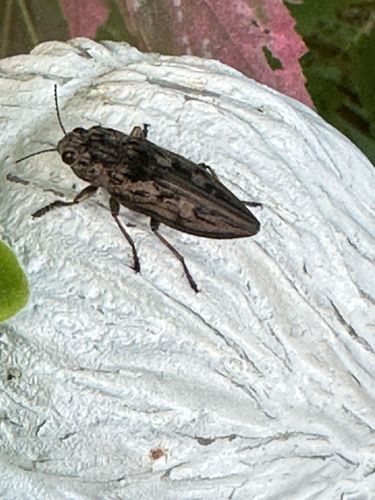
Flat-headed Borer (likely a species of Buprestid beetle)
Cannot determine the exact scientific name from the image alone, as there are many species within the Buprestidae family. It appears to be a species within the genus Buprestis or a related genus.
- Order & Family
- Order: Coleoptera, Family: Buprestidae
- Size
- Generally, flat-headed borers (Buprestidae) range from 3 mm to 50 mm in length, though many common species are between 10 mm and 30 mm.
Natural Habitat
Forests, woodlands, orchards, and urban areas with host trees. The larvae live inside the wood of trees, while adults are found on the tree surfaces or in nearby vegetation.
Diet & Feeding
Adult flat-headed borers typically feed on pollen and nectar, or sometimes on young bark. The larvae are wood-borers and feed on the phloem and sapwood of trees, creating tunnels under the bark.
Behavior Patterns
Adults are active during the day, especially in sunny areas. They often emerge from host trees and can be seen flying between trees or resting on bark. Larvae bore into wood, creating tunnels as they feed, which can severely damage or kill the host tree.
Risks & Benefits
Risks: Many species of flat-headed borers are significant pests of trees, particularly weakened or stressed trees. Their larval boring activity can girdle branches or entire trunks, leading to tree decline and death. Economically, they can cause considerable damage to timber, orchard trees, and ornamental trees. Benefits: In natural ecosystems, some species play a role in the decomposition of dead or dying wood, contributing to nutrient cycling. However, their destructive potential as pests generally outweighs their ecological benefits in managed environments.