
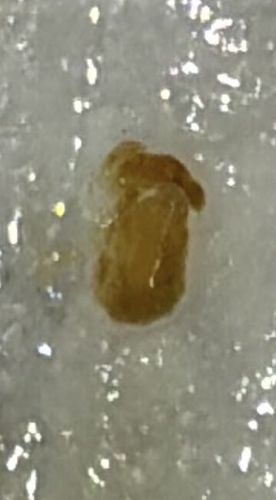
Community identification
Louse (likely Head Louse or Body Louse)
Pediculus humanus
- Order & Family
- Order: Psocodea (formerly Phthiraptera), Family: Pediculidae
- Size
- 2.0 mm to 3.5 mm in length
Natural Habitat
Exclusively on the human body, specifically hair follicles (head) or clothing seams (body).
Diet & Feeding
Obligate hematophagy; they feed exclusively on human blood multiple times a day.
Behavior Patterns
They are wingless and cannot jump or fly; they crawl and cling to hair or fabric with specialized claws. They reproduce rapidly via eggs called nits that are glued to hair shafts or clothing fibers.
Risks & Benefits
Risks include intense itching, scalp irritation, and secondary skin infections from scratching. Body lice can transmit serious diseases like typhus, though head lice are primarily a nuisance and do not spread disease.