
Community identification
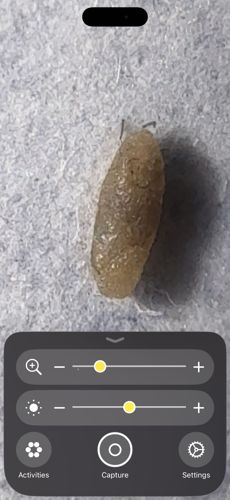
Fly Puparium (Fly Pupa)
Diptera (Suborder Brachycera)
- Order & Family
- Order: Diptera; Family: Muscidae or Calliphoridae (Commonly)
- Size
- 3 mm to 10 mm in length
Natural Habitat
Found in various environments ranging from soil and decaying organic matter to indoor locations near food sources.
Diet & Feeding
The pupa does not eat; it is a non-feeding life stage. The preceding larval stage (maggot) typically feeds on decaying organic material.
Behavior Patterns
Stationary phase of the life cycle where the larva transforms into an adult fly; the outer skin of the last larval instar hardens to form the protective puparium.
Risks & Benefits
Primarily a sanitation concern indoors; they can indicate the presence of decaying organic matter. Ecologically, they are vital for decomposition and nutrient recycling.