
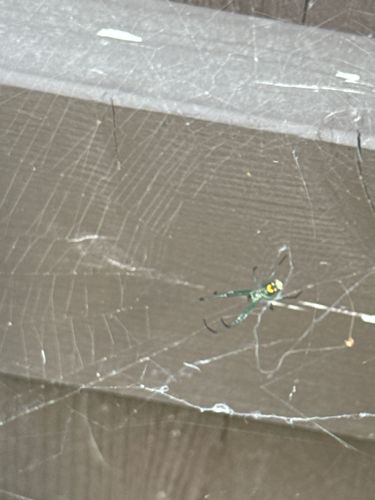
Orchard Orb-weaver
Leucauge venusta (or Leucauge argyrobapta, depending on region/taxonomy)
- Order & Family
- Order: Araneae, Family: Tetragnathidae
- Size
- Females typically have a body length of 5-8 mm (approx. 0.2-0.3 inches), while males are much smaller, usually 3-4 mm (approx. 0.1-0.15 inches).
Natural Habitat
These spiders are commonly found in gardens, orchards, woodlands, and other areas with abundant vegetation. They prefer to build their webs in shaded or semi-shaded areas, often among trees, shrubs, or tall grasses.
Diet & Feeding
The Orchard Orb-weaver primarily feeds on small flying insects such as flies, mosquitoes, moths, and other small arthropods that get caught in their sticky webs.
Behavior Patterns
Orchard orb-weavers are diurnal (active during the day) and construct orb webs to catch prey. The webs are typically built in open spaces between shrubs or trees. They are known to rebuild or repair their webs daily. Males are much smaller than females and will often reside on the female's web. Females fiercely guard their egg sacs, which are usually camouflaged among leaves.
Risks & Benefits
Orchard Orb-weavers are not considered dangerous to humans. Their venom is mild and typically only causes localized pain or swelling if a bite occurs, which is rare as they are not aggressive. They are highly beneficial to ecosystems as natural pest controllers, consuming a large number of nuisance insects. Their webs also help maintain ecological balance.