
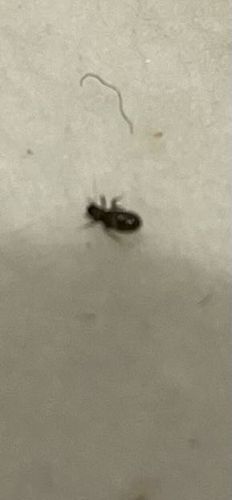
Booklouse (or Psocid)
Various species within Psocoptera, for example, Liposcelis spp. for common indoor booklice.
- Order & Family
- Order: Psocoptera (also known as Psocodea, which includes Phthiraptera); Family: Varies widely, depending on species, e.g., Liposcelididae (known as 'fat booklice'). Due to the image quality, species/family identification beyond order is difficult.
- Size
- Typically 1-2 mm, though some species can be up to 5-6 mm. The one in the image appears to be on the smaller end of this range.
Natural Habitat
Indoors, they prefer damp and humid environments such as bathrooms, basements, kitchens, and areas with water damage or high humidity. They are commonly found in old books, stored papers, food pantries, and under wallpaper. Outdoors, they live in similar damp conditions under bark, in leaf litter, or on fungi.
Diet & Feeding
Booklice feed on mold, fungi, starches, glues in book bindings, wallpaper paste, paper, and other organic matter found in humid environments. They are scavengers.
Behavior Patterns
Booklice are often found in damp, dark, and undisturbed areas. They are very active and move quickly. They reproduce rapidly, especially in favorable conditions (high humidity, moderate temperatures). While most are wingless, some species may have wings. They are not typically social insects.
Risks & Benefits
Risks: Considered a nuisance pest when found indoors in large numbers. While they do not bite humans or transmit diseases, they can contaminate food products and damage books, textiles, and other starchy materials, particularly in conditions that promote mold growth. They can also indicate underlying moisture issues in a building. Benefits: Outdoors, they play a minor role as decomposers, helping to break down organic matter.