
Common House Fly Identification Guide
Identify the common house fly by its gray striped thorax, reddish eyes, and quick, erratic flight indoors.
Read the full Common House Fly encyclopedia entry →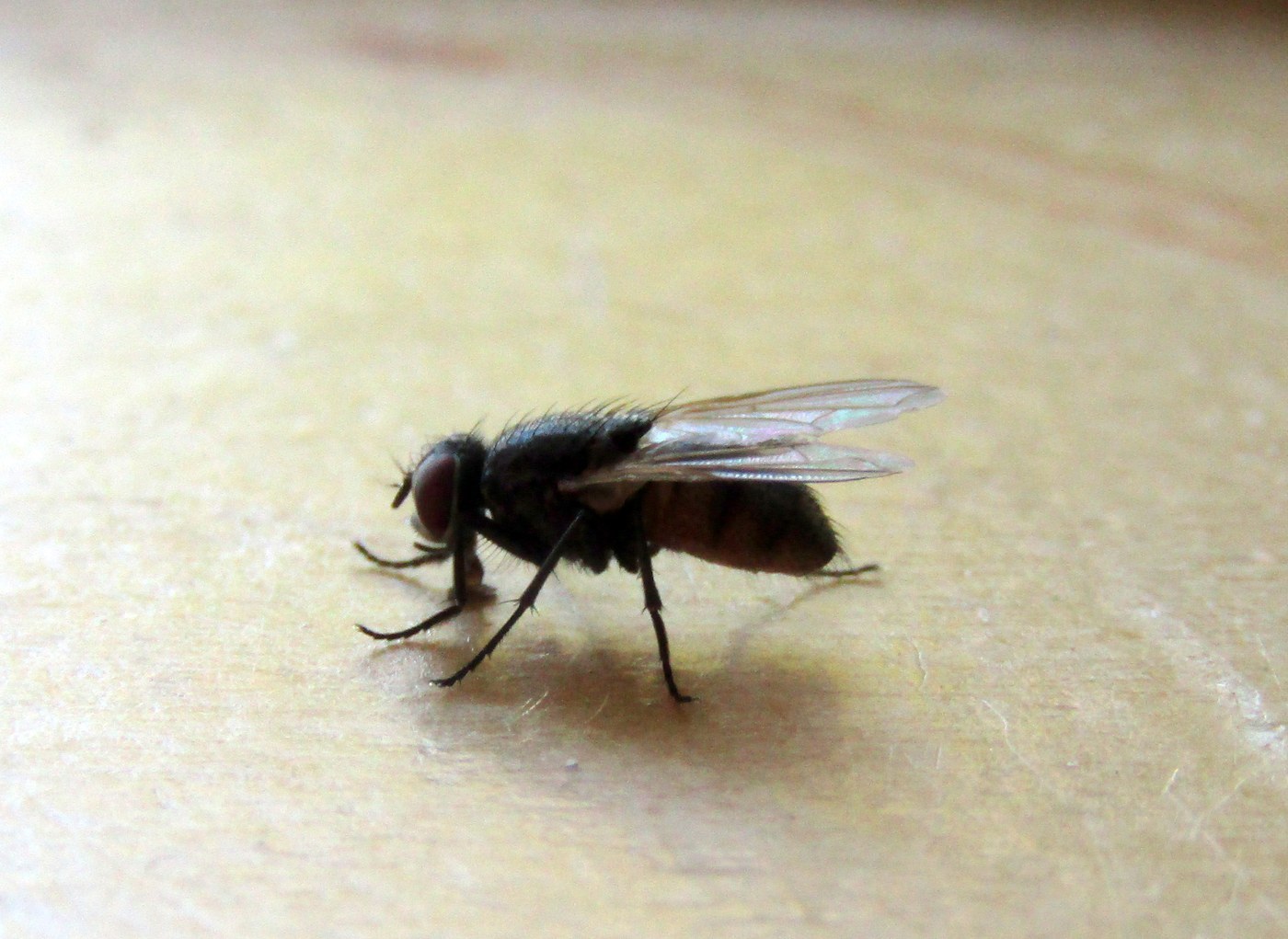
Key Visual Features
The common house fly (Musca domestica) is one of the most widespread and recognizable flies found around homes.
- Size: adults are about 1/4 to 3/8 inch long.
- Color: dull gray thorax marked with four dark, narrow, longitudinal stripes running down the back; the abdomen is a mix of gray with some yellowish or brownish tones underneath.
- Eyes: large, reddish to dark red, taking up much of the head, giving broad vision.
- Body shape: compact and stout, with a single pair of functional wings (true flies have only one pair, with the second pair reduced to small balancing organs called halteres).
- Mouthparts: sponge-like, used for lapping up liquid and semi-liquid materials rather than biting.
- Legs: covered in fine hairs and equipped with small sticky pads that allow it to walk on smooth vertical surfaces and ceilings.
Where and When You'd See It
- Common around homes, kitchens, garbage areas, and anywhere food waste or organic matter is present.
- Active during the day, resting at night on ceilings, walls, or hanging wires.
- Most abundant in warm months, with populations dropping in cold weather.
- Known for fast, erratic, zigzagging flight and a persistent buzzing sound.
Similar-Looking Bugs
- Blow flies: noticeably shiny metallic blue or green, unlike the dull gray, striped body of the house fly.
- Flesh flies: gray with a checkerboard pattern on the abdomen rather than four straight stripes on the thorax.
- Fruit flies: much smaller with tan to reddish-brown bodies and red eyes, often seen hovering near ripening produce rather than general household areas.
Behavior Notes
House flies tend to land frequently, alternating short flights with brief pauses on surfaces, and can often be seen rubbing their front legs together while resting. They are drawn indoors through open doors and windows, especially where food odors or garbage are present, and tend to gather on sunny windows when trying to find a way back outside.
Quick ID Checklist
- Dull gray thorax with four dark longitudinal stripes
- Large reddish eyes
- Single pair of functional wings
- Sponge-like mouthparts
- Fast, erratic flight and buzzing sound indoors
Frequently asked questions
How can I tell a common house fly from a blow fly?
House flies have a dull gray, striped body, while blow flies have a shiny metallic blue or green body.
What do the stripes on a house fly's back look like?
There are four narrow, dark longitudinal stripes running down the gray thorax.
Does the common house fly bite?
It has sponge-like mouthparts designed for lapping up liquids rather than biting.
What color are a house fly's eyes?
They are large and reddish to dark red, covering much of the head.