
Mud Wasp Identification Guide
A field guide to spotting the slender, thread-waisted wasps that build distinctive mud tube nests on walls and eaves.
Read the full Mud Wasp encyclopedia entry →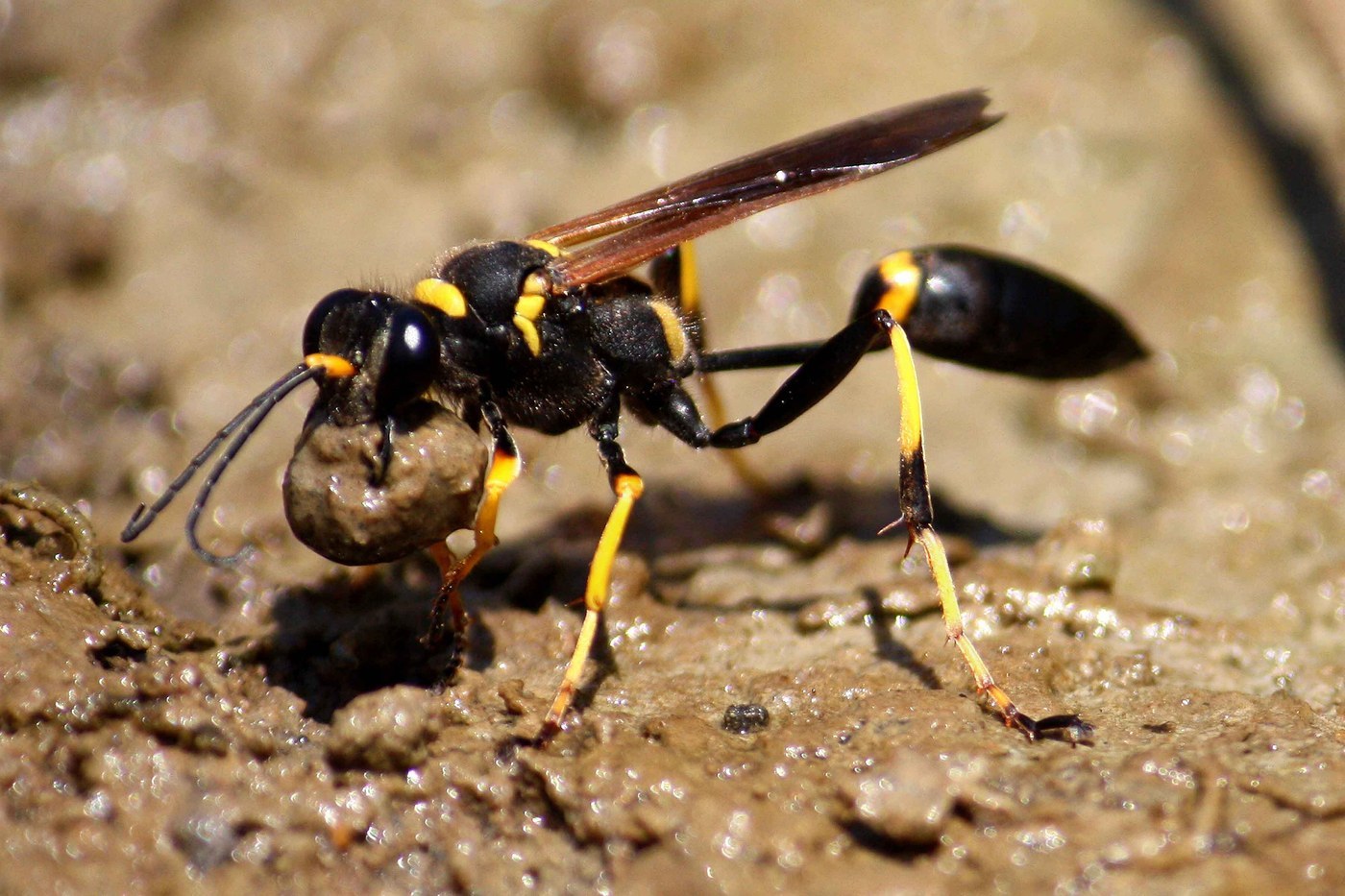
Key Visual Features
Mud wasps (mud daubers) are solitary wasps best recognized by their extremely narrow, thread-like waist and their habit of building nests from wet mud.
- Size: Roughly 20–28 mm (0.8–1.1 inches) long, slender-bodied.
- Color: Many species are solid black or metallic blue-black with an iridescent sheen; others show black bodies with pale yellow leg or thread markings.
- Body shape: A long, thin "thread waist" (petiole) connects the thorax to a slim, tapered abdomen, giving the whole insect a stretched-out look.
- Wings: Smoky-tinted, folded flat along the back at rest.
- Legs: Long and thin, often trailing noticeably below the body during flight.
- Antennae: Slender and dark, in constant slow motion while the wasp works.
Where and When You'll See One
Mud wasps are most conspicuous around their construction sites rather than in open habitat.
- Look on sheltered vertical surfaces: house eaves, porch ceilings, barn walls, garages, and under bridges.
- Nests appear as rows of side-by-side mud tubes or a smooth mud "pot" cluster, later plastered over into a lumpy mud patch.
- Adults are active on warm days in spring and summer, seen gathering mud at puddle edges or damp soil, then flying it back to the nest site.
- Because they are solitary, you'll usually see one wasp at a time working alone, not a group defending a colony.
Similar-Looking Bugs
- Potter wasps: Also build mud structures, but their nests are small individual jug- or pot-shaped cells rather than tube clusters.
- Paper wasps: Build gray papery combs, not mud, and have a much less exaggerated waist.
- Spider wasps: Similar thread-waisted body shape but do not build mud nests; instead they hunt and drag spiders into existing crevices.
- Carpenter bees: Much stockier and fuzzier, with no thread waist, and they bore into wood rather than build with mud.
Quick ID Checklist
- Extremely thin, thread-like waist separating thorax and abdomen
- Solid black or metallic blue-black coloring, sometimes with pale markings
- Found alone at or near rows of mud tube nests on sheltered structures
- Long trailing legs visible in flight
- Seen collecting mud at puddles or damp ground
Frequently asked questions
What does a mud wasp nest look like?
It typically appears as a cluster of parallel, cylindrical mud tubes, often later smoothed over into a single lumpy mud patch on a sheltered wall or ceiling.
Are mud wasps social like yellowjackets?
No, mud wasps are solitary — each female builds and provisions her own nest alone rather than living in a group colony.
How do I tell a mud wasp from a potter wasp?
Mud wasps build elongated tube-shaped nests in rows, while potter wasps construct small, rounded, jug-shaped mud pots, often one at a time on twigs or walls.
Why do I see the wasp visiting puddles?
It is collecting wet mud in its mandibles to carry back and shape into nest tubes or to repair existing ones.