
Spotted Lanternfly Identification Guide
Learn to recognize this striking planthopper by its gray spotted wings, red hindwings, and clustered egg masses.
Read the full Spotted Lanternfly encyclopedia entry →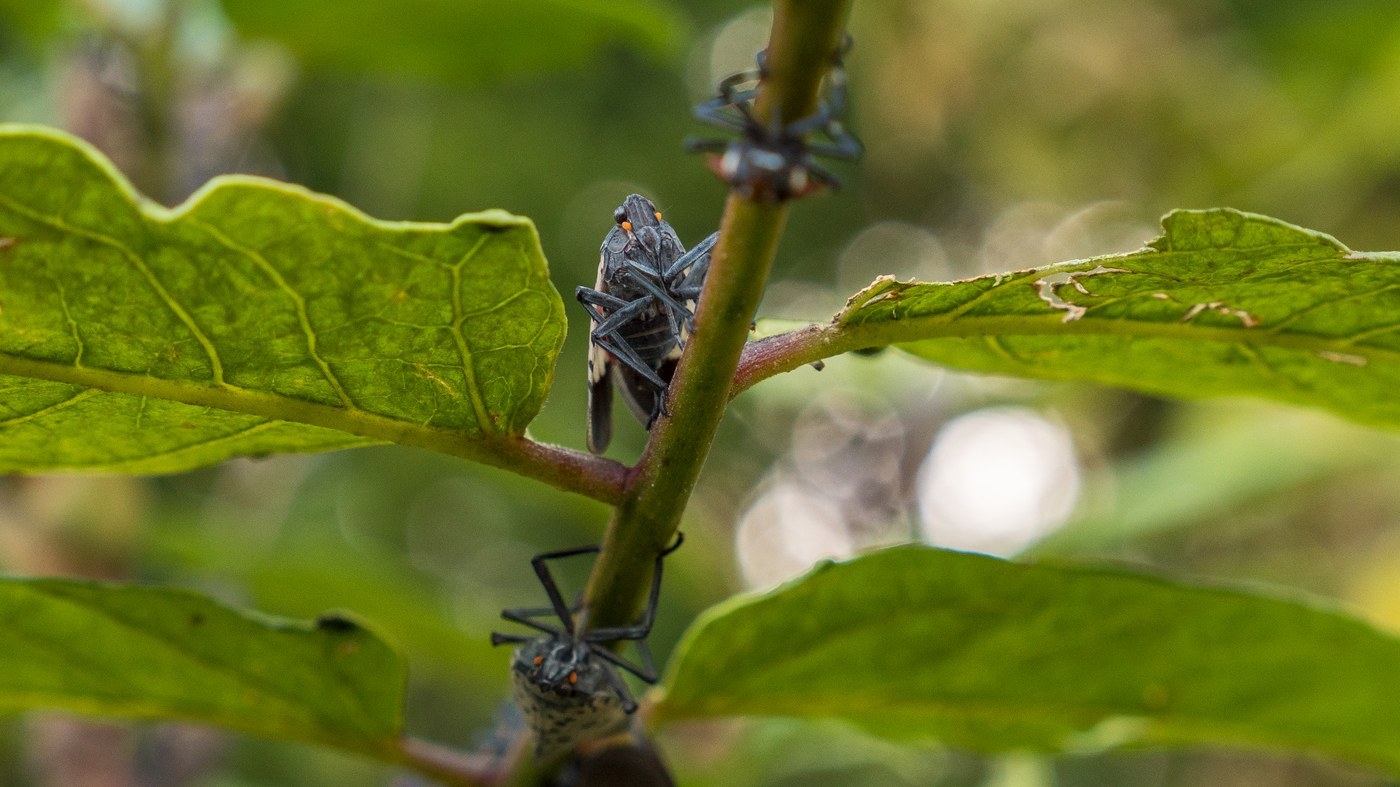
Key Visual Features
The spotted lanternfly is a large planthopper, not a true fly or moth, and its appearance changes dramatically through its life stages.
- Adults are about 1 inch (2.5 cm) long with folded, tent-like forewings that are pale gray to tan and covered in black spots near the base, becoming a black-spotted, brick-patterned tip.
- When the forewings open or the insect is in flight, they reveal bright scarlet-red hindwings marked with black spots and a black-and-white barred edge.
- The body and legs are black, and the abdomen is yellow with black bands, visible when the wings are spread.
- Nymphs look completely different: early-stage nymphs are small, wingless, and black with white spots, while the final nymph stage turns bright red with white spots and black patches before molting into an adult.
- The head is small and pointed, with short antennae, and the insect holds its wings roof-like over its back at rest.
Where and When You'd See It
Spotted lanternflies are found on tree trunks, vines, and stems, often in large clustered groups. They are strongly associated with tree-of-heaven but will also gather on grapevines, maples, walnuts, and many other woody plants. Nymphs appear in spring and early summer, while winged adults become common from mid-summer through fall. In autumn, adults lay egg masses—flat, gray, putty-like smears about an inch long—on tree bark, stones, vehicles, or any smooth outdoor surface, where they overwinter until nymphs emerge the following spring.
Similar-Looking Bugs
- Other planthoppers may share the general triangular wing shape but lack the bold black spotting and red hindwing flash.
- Gypsy moth caterpillars and other larvae are sometimes confused with lanternfly nymphs, but true caterpillars have a segmented, worm-like body with prolegs, unlike the hard-shelled, hopping nymphs of the lanternfly.
- Leafhoppers are smaller and lack the distinct spotted pattern and red underwing.
- The combination of spotted gray forewings and red-and-black hindwings is unique enough that few insects are truly mistaken for an adult spotted lanternfly once both wing surfaces are seen.
Quick ID Checklist
- Folded wings are pale gray/tan with black spots and a speckled tip
- Hindwings flash bright red with black spots when open
- Nymphs are black with white spots when young, red with white spots when older
- Found in dense clusters on tree trunks and vines
- Egg masses look like gray, mud-like smears on bark or flat surfaces
Frequently asked questions
How can I tell a spotted lanternfly nymph from an adult?
Nymphs are wingless and either black with white spots (early stages) or bright red with white spots (final stage), while adults have fully developed gray, black-spotted forewings and can fly.
What does a spotted lanternfly egg mass look like?
Egg masses appear as flat, gray-brown, putty-like smears roughly an inch long on tree bark or other smooth surfaces, often described as looking like dried mud.
Do spotted lanternflies fly well?
They are better at hopping and gliding short distances than sustained flying, often using their strong hind legs to jump before opening their wings.
Why do I see so many spotted lanternflies together?
They are gregarious feeders and commonly cluster in groups of dozens on a single tree trunk or vine, especially on preferred host plants.