Tomato Hornworm Moth (Five-spotted Hawkmoth) Identification Guide
Count the five pairs of orange abdominal spots to confirm this large, hovering sphinx moth.
Read the full Tomato Hornworm Moth (Five-spotted Hawkmoth) encyclopedia entry →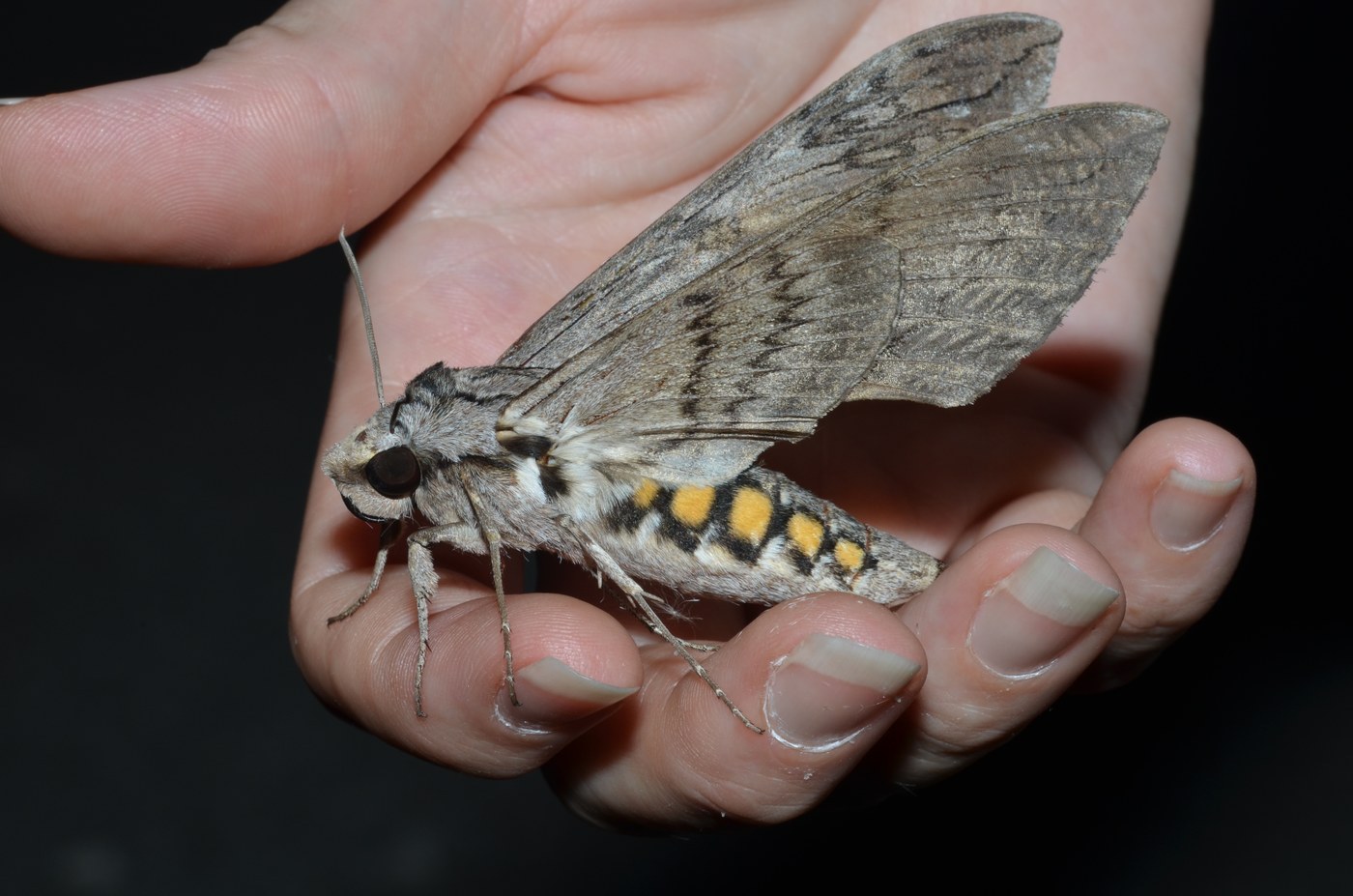
Key Features
- Large, robust-bodied moth, wingspan around 10–13 cm (4–5 inches)
- Narrow, elongated forewings in mottled gray-brown with fine black zigzag lines, built for fast, sustained flight over long distances
- Hindwings are shorter with alternating dark and pale bands, mostly hidden by the forewings at rest
- The common name comes from five (occasionally six) pairs of bright yellow-orange spots running down each side of the abdomen — the clearest identifying feature and the source of the moth's name
- Thick, spindle-shaped body tapering at both ends, typical of sphinx/hawk moths, with strong flight muscles packed into the thorax
- Long proboscis, coiled at rest, used for feeding on deep tubular flowers while hovering in place
Where & When to Spot One
- Found across most of North America, from southern Canada to Mexico, in gardens, agricultural fields, meadows, and open areas
- Primarily nocturnal, though sometimes active at dusk, when it hovers at flowers much like a hummingbird
- Adults fly from late spring through summer, with one or two generations depending on region and local temperatures
- Frequently attracted to lights at night and to fragrant, pale-colored flowers such as evening primrose and moonflower at dusk, when their scent is strongest
Similar Species
- Other sphinx moths in the same family share the narrow-winged, torpedo-shaped body, but the five pairs of orange abdominal spots are diagnostic for this species
- The related tobacco hornworm moth is extremely similar in size and shape but typically shows six pairs of spots and slightly different wing markings — close inspection of the abdomen spots is the most reliable way to separate the two
- Hummingbird Hawk-Moths are far smaller and lack the abdominal spot pattern entirely, making size alone a useful first clue
- Other large gray sphinx moths lack the consistent row of paired orange abdominal spots seen in this species
Quick ID Checklist
- Five pairs of orange spots along the abdomen
- Large size with narrow, torpedo-shaped wings
- Mottled gray-brown forewings with fine zigzag lines
- Hovers at flowers at dusk, coiled proboscis when not feeding
- Found in gardens and open fields across North America in summer
Frequently asked questions
How do I count the abdominal spots to confirm this species?
Look along each side of the abdomen for five paired yellow-orange spots; this is the feature that gives the moth its common name.
When is this moth most active?
Mainly at dusk and after dark during late spring and summer months.
How is it different from the tobacco hornworm moth?
The two are very similar, but the tobacco hornworm moth usually has six pairs of abdominal spots rather than five, along with subtle wing pattern differences.
Why does it hover at flowers?
Its long coiled proboscis and hummingbird-like hovering flight let it feed on nectar from deep, tubular flowers at dusk.
Tomato Hornworm Moth (Five-spotted Hawkmoth) identified by the community
Recent Tomato Hornworm Moth (Five-spotted Hawkmoth) finds identified with Bug Identifier.