Trap-Jaw Ant Identification Guide
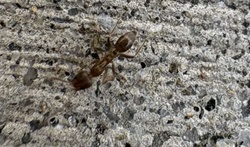
Identify trap-jaw ants by their long, straight mandibles held wide open and their slender, elongated reddish-brown body.
Read the full Trap-Jaw Ant encyclopedia entry →Key Visual Features
Trap-jaw ants (genus Odontomachus) are unmistakable once you spot the jaws:
- Medium size, roughly 8-12mm, notably larger than many common household ants
- Slender, elongated body, colored reddish-brown to nearly black
- Long, straight mandibles that can be held open at close to 180 degrees, ready to snap shut
- Large, prominent eyes set on an elongated head
- A narrow waist with a single node, often topped with a small spine
- Long legs suited to quick movement and short jumps
Where and When You'll See Them
Trap-jaw ants are typically found in leaf litter, under rotting logs, and in loose soil within wooded, subtropical, and tropical habitats. In the United States, they're most associated with the warmer southeastern states. They tend to forage during cooler, low-light periods — dusk, dawn, or at night — and are most often discovered by turning over logs, bark, or leaf litter during warm seasons. Colonies are usually modest in size compared to many other ant species, and nests are often tucked beneath decaying wood, in soil cavities, or under stones in shaded, moisture-retaining spots. Individual workers can also cover short distances with a sudden backward jump, powered by the same rapid mandible snap used for feeding, which can startle an observer who gets too close.
Similar-Looking Bugs
- Other elongated, slender ants can superficially resemble trap-jaw ants at a glance, but none share the same dramatic, straight-line mandibles locked open at nearly 180 degrees — this feature alone is diagnostic.
- Larger stinging ants in tropical regions may share the elongated body plan, but their mandibles are curved and used for grasping and chewing rather than the trap-like snap of Odontomachus.
- Some other ant genera also possess elongated jaws, but few combine the same long, straight, wide-gaping mandibles with the spined single waist node characteristic of trap-jaw ants.
Quick ID Checklist
- Medium-large, slender, reddish-brown to black body, 8-12mm
- Long, straight mandibles held wide open
- Large eyes and elongated head
- Single waist node, often spined
- Found in leaf litter and rotting logs, most active at dusk or night
Frequently asked questions
What makes trap-jaw ant mandibles unique?
They can be locked open at nearly 180 degrees and snap shut extremely quickly when triggered, unlike the curved, grasping jaws of most other ants.
How big are trap-jaw ants?
They typically measure 8-12mm, making them noticeably larger and more slender than many common backyard ants.
Where are trap-jaw ants usually found?
They favor leaf litter, rotting logs, and loose soil in wooded, warm, humid habitats, and are most active during low-light periods like dusk and night.
How can I tell a trap-jaw ant from other elongated ants?
Look at the mandibles — trap-jaw ants have distinctively long, straight jaws held wide open, a feature not shared by most other elongated ant species.
Trap-Jaw Ant identified by the community
Recent Trap-Jaw Ant finds identified with Bug Identifier.