
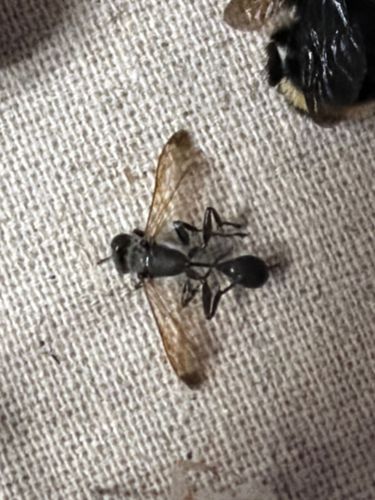
Community identification
Ant-mimic fly (Thick-headed fly)
Physocephala sp.
- Order & Family
- Order Diptera, Family Conopidae
- Size
- Generally 8 mm to 15 mm in length.
Natural Habitat
Meadows, gardens, and woodlands where flowers and host bees/wasps are abundant.
Diet & Feeding
Adults feed on nectar from flowers; larvae are endoparasitoids of adult bees and wasps.
Behavior Patterns
They exhibit mimicry by resembling wasps or ants in both appearance and flight. Females are known to intercept bees in flight to deposit an egg on them. The larva then develops inside the abdomen of the living host, eventually killing it.
Risks & Benefits
They pose no physical risk to humans. In the ecosystem, they serve as pollinators as adults, though they act as natural controllers (parasitoids) of bee and wasp populations, which can sometimes be viewed as a negative impact on beneficial pollinators.