
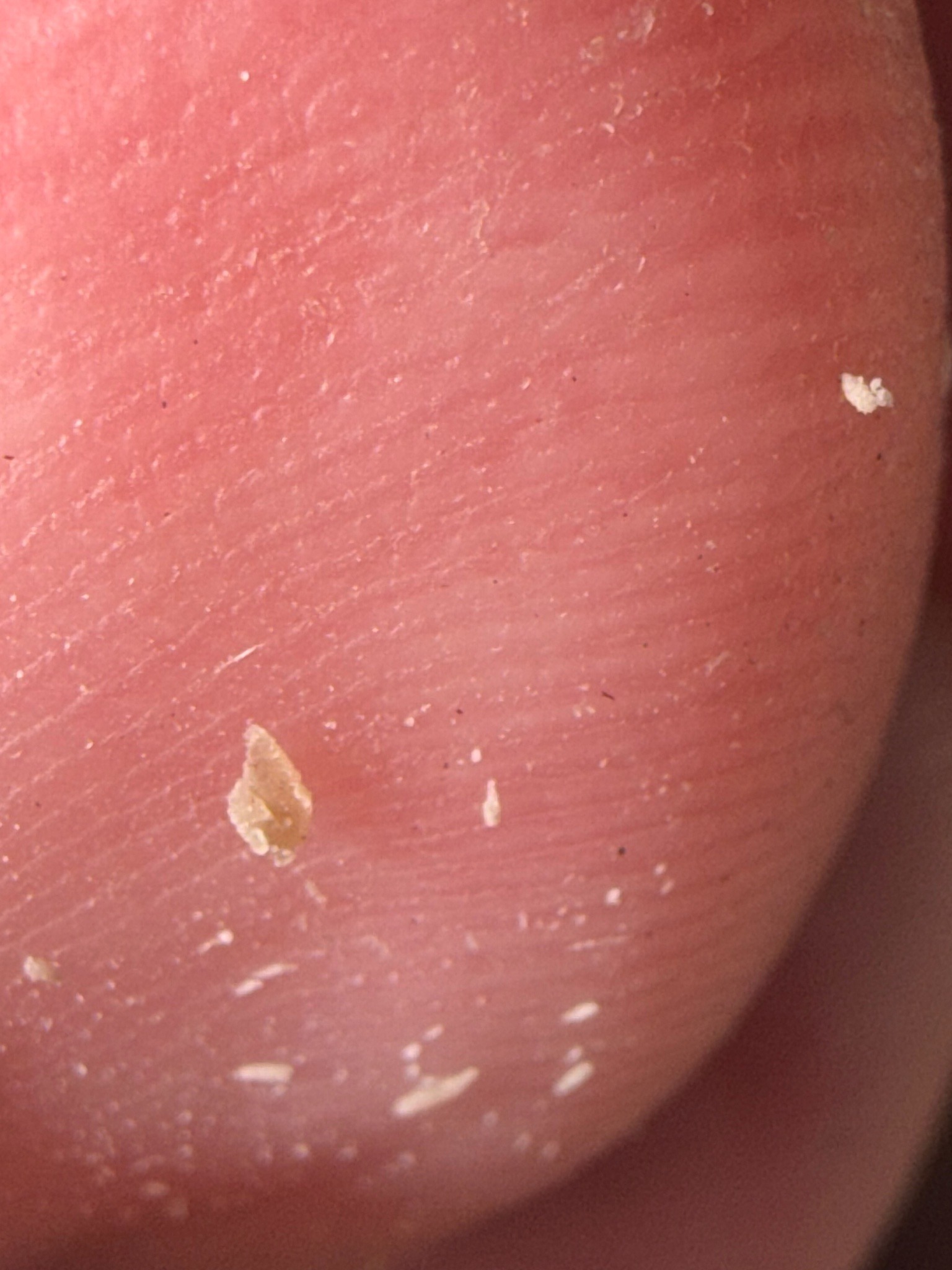
Community identification
Likely head louse egg (nit)
Pediculus humanus capitis
- Order & Family
- Phthiraptera (often classified within Psocodea), Pediculidae
- Size
- Nits are about 0.8–1 mm long; adult head lice measure roughly 2–3.5 mm.
Natural Habitat
Attached firmly to human scalp hair, usually near the roots, where warmth supports development. The pictured object may be a detached or empty nit; identification is uncertain because no hair shaft is visible.
Diet & Feeding
Adults and nymphs feed exclusively on small amounts of human blood by piercing the scalp.
Behavior Patterns
Wingless lice crawl rather than jump or fly; females cement eggs to hair shafts, and eggs hatch in approximately 7–10 days. Transmission occurs mainly through direct head-to-head contact.
Risks & Benefits
Head lice cause itching, irritation, and scratching-related skin infection but do not generally transmit serious disease. They provide no meaningful human benefit.