
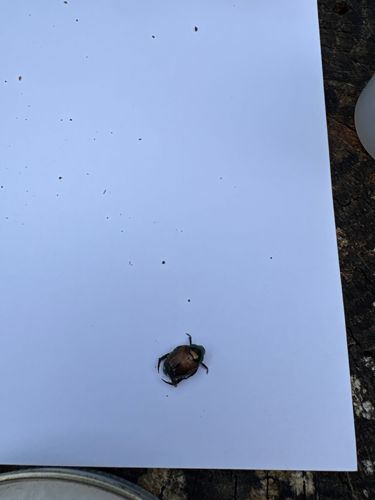
Japanese Beetle
Popillia japonica
- Order & Family
- Order: Coleoptera, Family: Scarabaeidae
- Size
- Adults typically measure 8-11 mm (0.3-0.4 inches) in length.
Natural Habitat
Japanese beetles are commonly found in lawns, gardens, agricultural fields, nurseries, and urban landscapes where their host plants are abundant.
Diet & Feeding
Adult Japanese beetles feed on over 300 species of plants, including ornamentals, fruits, vegetables, and shade trees, skeletonizing leaves by eating the tissue between the veins. Larvae (grubs) feed on the roots of grasses and other plants.
Behavior Patterns
Adult Japanese beetles are active during the day, feeding on plants and laying eggs in turf. They are strong fliers and can travel significant distances. Larvae (grubs) live underground and feed on plant roots.
Risks & Benefits
Risks: Japanese beetles are highly destructive agricultural and ornamental pests, causing significant damage to crops, gardens, and landscapes. Benefits: While they are major pests, their impact on the ecosystem is primarily negative in invaded areas.